
NEW Program Alert: The Groove Accelerator is OPEN for enrollment! Limited Time Only —Join Now
The Bass Guitar Pattern to Change Everything (And It’s EASY)
Today we’re about to uncover a hidden gem—a simple and secret bass guitar pattern on your fingerboard that promises to revolutionize your understanding of keys and chords.
If that sounds like a big claim, it’s because it is.
Seriously, this secret bass guitar pattern is something you’ll use forever.
It’ll help you:
- Instantly know every chord, in every key.
- Demystify bass music theory and show you how to use it to create bass lines.
- Understand songwriting, the big picture of chord theory, and help you write your own songs.
- When playing with (and communicating) with other musicians in bands and jam sessions.
And the best bit…
It’s EASY to get this down.
Let’s jump in!
Originally published on January 17, 2019, this article was updated and republished on April 15th, 2024.
Bass Patterns for Deciphering Chords in a Key
First things first, let's talk about key signatures. Each key has a predictable set of chords that sound good together in a song. Songwriters use this all the time, and that’s why you hear so many songs with similar chord patterns.
As a bass player, you need to know this! The key tells you which chords and notes to build into your bass line.
Picture the seven notes of the C major scale in your mind. Following the Nashville Number System, assign each note a number from one to seven.
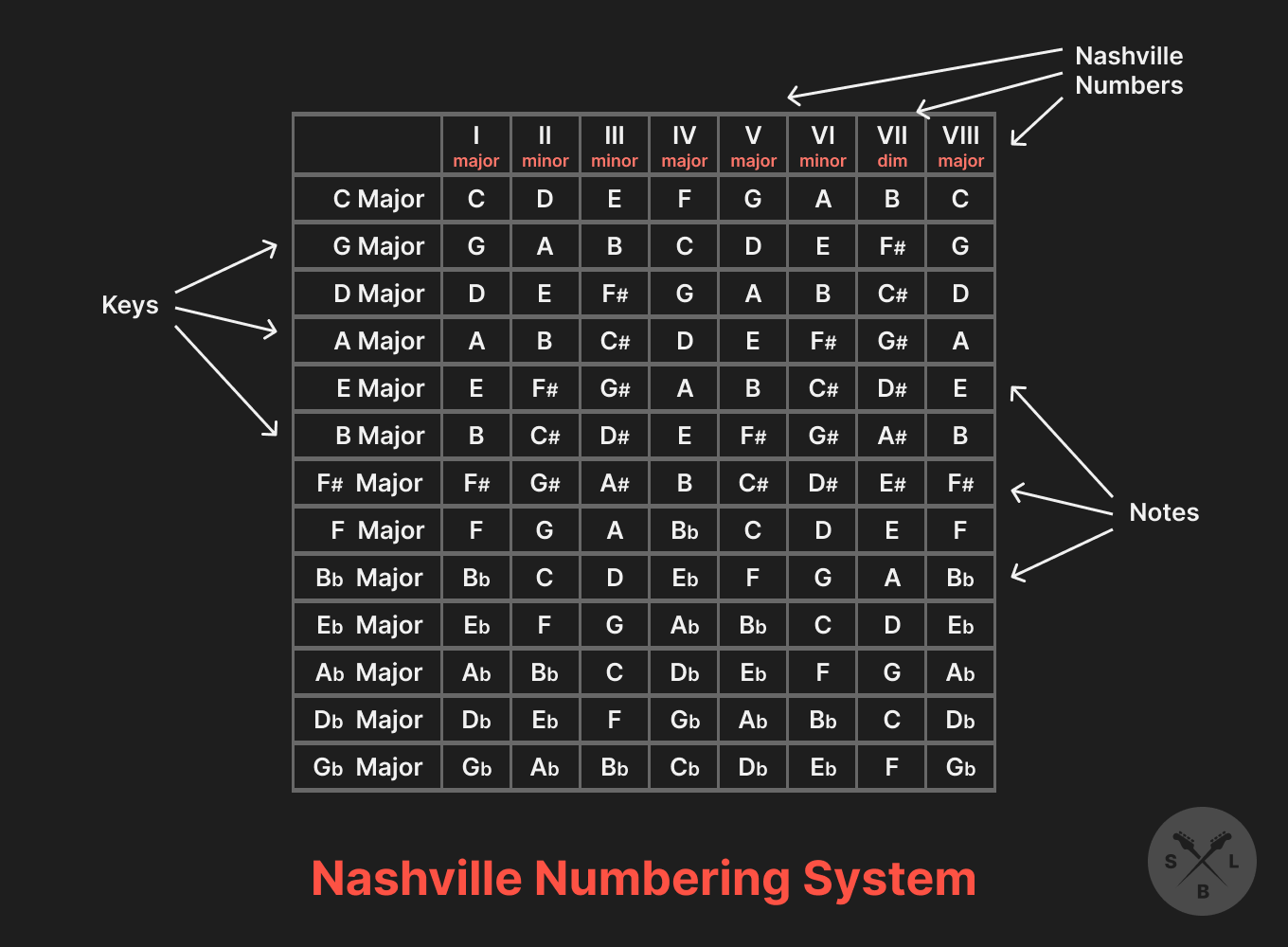
Here's the breakdown for the key of C:
1. C major
2. D minor
3. E minor
4. F major
5. G major
6. A minor
7. B diminished or B half-diminished
This sequence stays the same no matter what key you’re in! Just write out the seven notes of the major scale, and follow the pattern: Major, minor, minor, major, major, minor, diminished.
You’ll also see it written like this: I, ii, iii, IV, V, vi, vii°.
The only problem is that it’s quite a lot of information to remember – especially when you’re in the moment, trying to come up with a killer bass line.
If you condense it to the point where you can access it instantly, you can use it in songs, scales, chords, and everything else! You’ll never again have to wonder, “What chords are in this key?”
This is where the bass guitar pattern comes into play. It simplifies the sequence down to three steps:
1. Start with your first finger on the root note. Let’s use the key of C again. In this case, the root note is C.
2. Move to the same fret on the next string. In this case, the note would be F.
3. Go three frets up from there. Finally, you end up on a G.
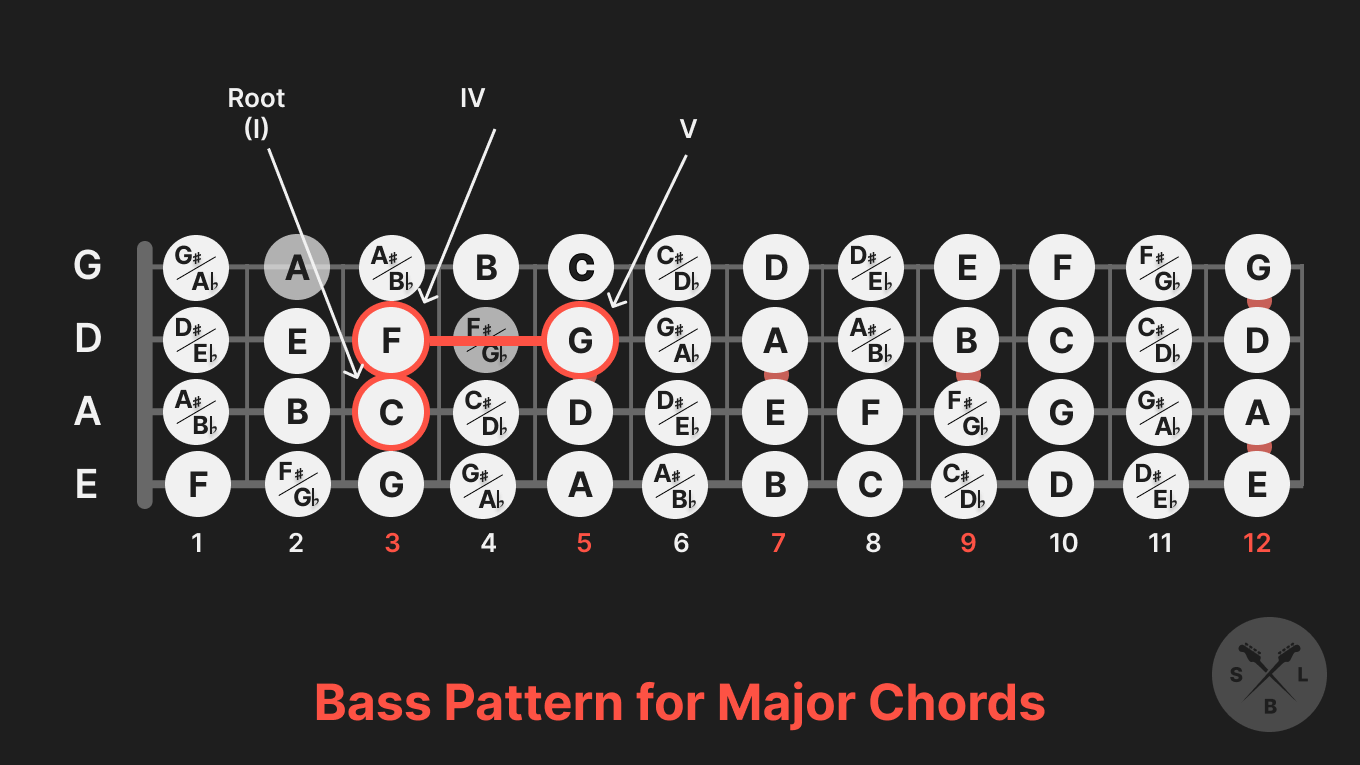
This simple pattern reveals all the major chords within the key. For the key of C major, you were able to find C major, F major, and G major using this pattern.
Cool, right?
But this isn’t all—we can also find the minor chords using a similar pattern:
1. Start with your first finger on the root note. In this case, it’s C.
2. Count three frets down from there. Here we get A.
3. Play the same pattern as before.
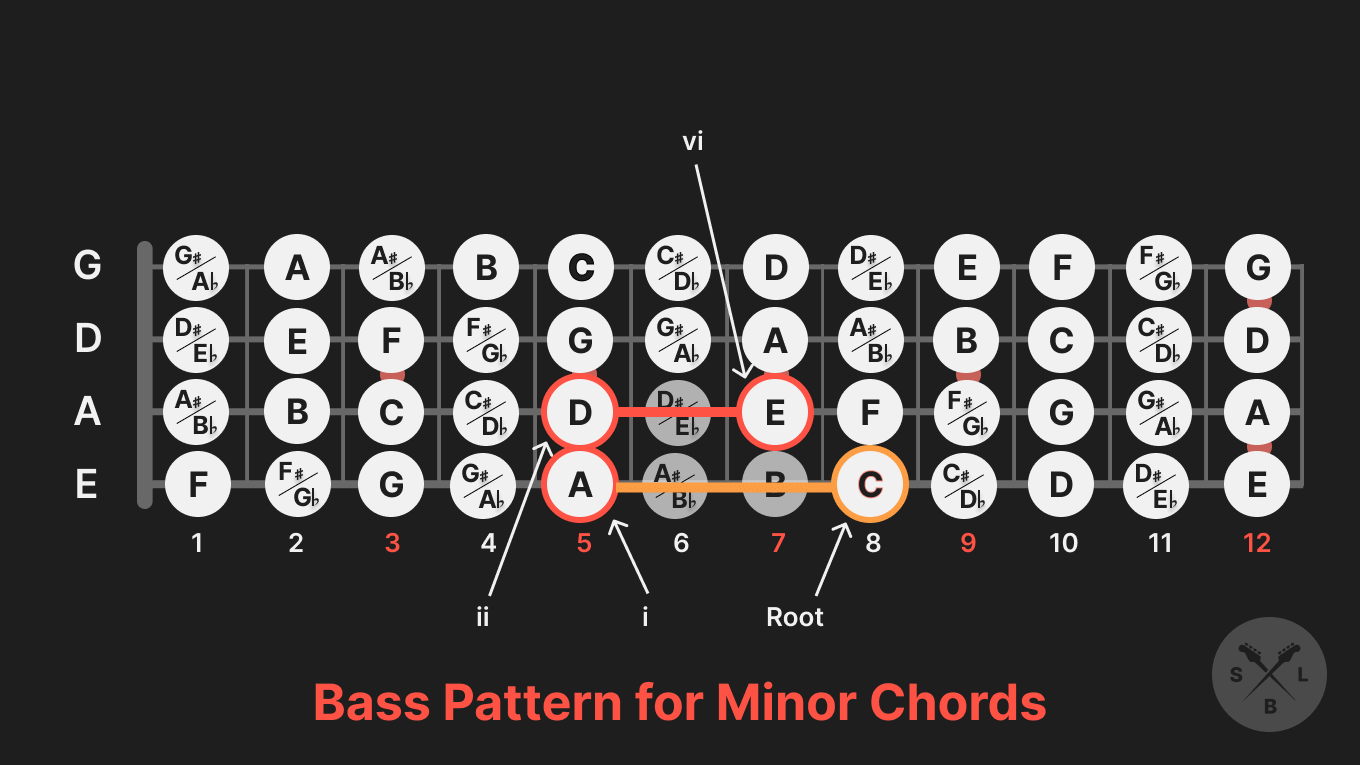
This reveals all the minor chords within the key. So in the key of C major, you'll find A minor, D minor, and E minor using this pattern.
Look for Patterns to Identify the Key Signature
What if you don’t know the key signature of the song? This pattern is also a cheat code for figuring that out on the fly!
Look for these chord pattern clues to find the most likely key of any song you’re playing:
- When you see two major chords a fourth apart, they're likely chords I and IV.
- When you see two minor chords a fourth apart, they're likely chords vi and ii.
- If you come across two minor chords a tone apart, they're probably chords II and III.
These tricks are gold dust for quickly deciphering the key of a song and figuring out major and minor chords while jamming with friends or performing live!
Ready for More Game-Changing Bass Secrets?
The SBL Academy has everything you need to level up your bass playing. It’s filled to the brim with video lessons from some of the world’s best bass players who’ll teach you holy bass grails like the bass guitar pattern above.
They’ve dedicated their lives to distilling the secrets of bass playing down into the most accessible and manageable courses on the internet—and you can find it all in the Academy.
Start your free 14-day free trial today!