How to Read Bass Tabs (A-Z Beginner's Guide)
When you first picked up the bass, I’m guessing you didn’t start by reading a book. You dove straight into playing your shiny new bass!
And while there’s nothing wrong with this approach, you’ll find that some reading is really helpful for growing as a player. If you really want to see how a song is laid out, what type of rhythm it uses, and what techniques to use, you need some kind of musical notation to guide you.
At this point, a lot of people get scared because they think I’m talking about sheet music.
But there’s actually a better, more straightforward method that’s perfect for beginners – bass guitar tablature, or bass tabs.
Tabs are a really useful and simple way to read music. Once you know tabs, you can pick up bass lines and solos a lot faster, and generally get a much better understanding of the music you’re playing.
If you’re new to reading music, here’s a simple, beginner’s guide to decoding all those lines and symbols, so you can turn bass tabs into bass grooves.
What Are Bass Tabs?
There are two main ways of reading bass music:
- Bass tabs – a quick and easy method using numbers and symbols.
- Standard musical notation – a more complex notation method that can be very handy once you’re a more advanced bass player.
Think of both of these methods as the language with which you can read bass guitar music. While neither is better than the other, they are more suited to different stages of your bass-playing journey.
Bass tabs use a very simple set of lines and numbers to represent the different strings and frets on the guitar. They narrow down exactly what you have to play and where to play it.
There are two different ways of writing tabs. While they look pretty different from each other, the rules for reading them remain mostly the same:
- Text-based tab – an older version of tablature written with text characters.
- Tab and standard notation – a more modern version of tablature that includes standard notation.
Have a look at each of these in the diagram below:
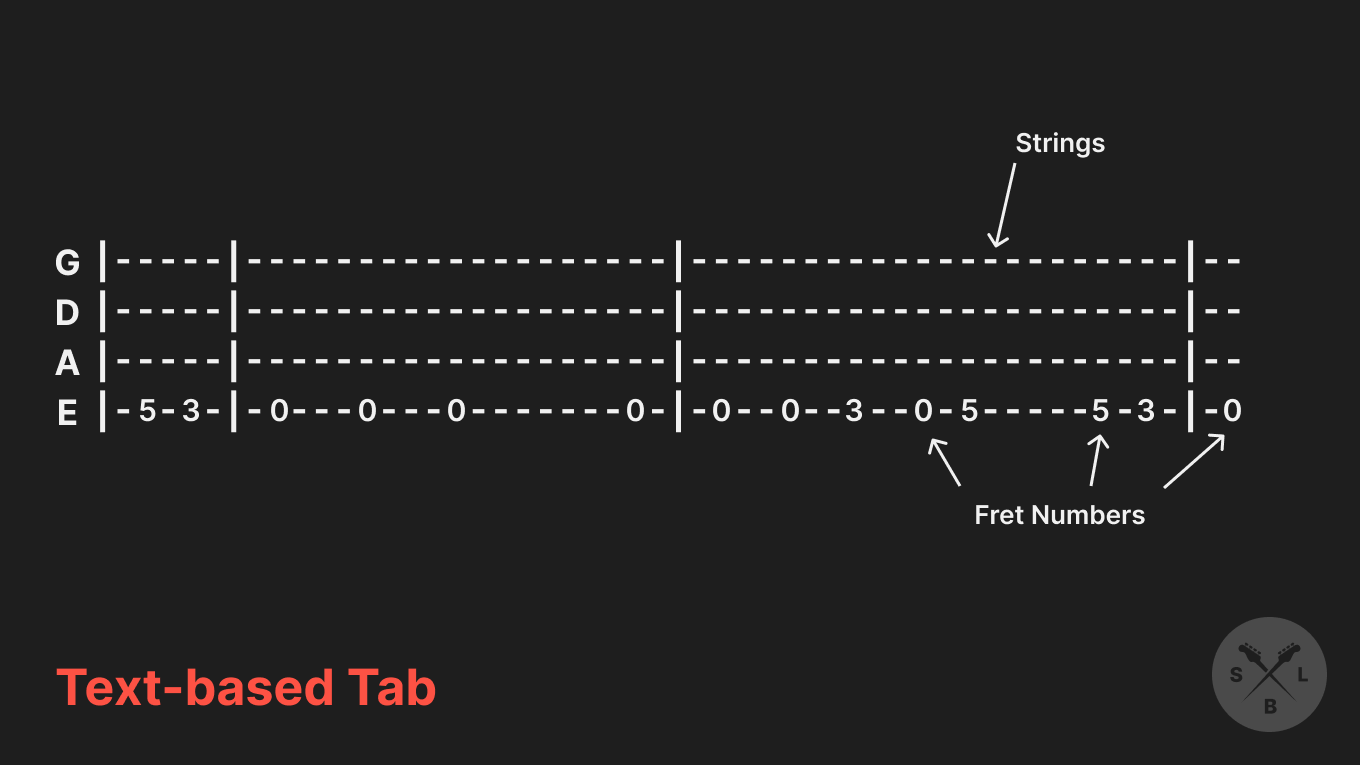
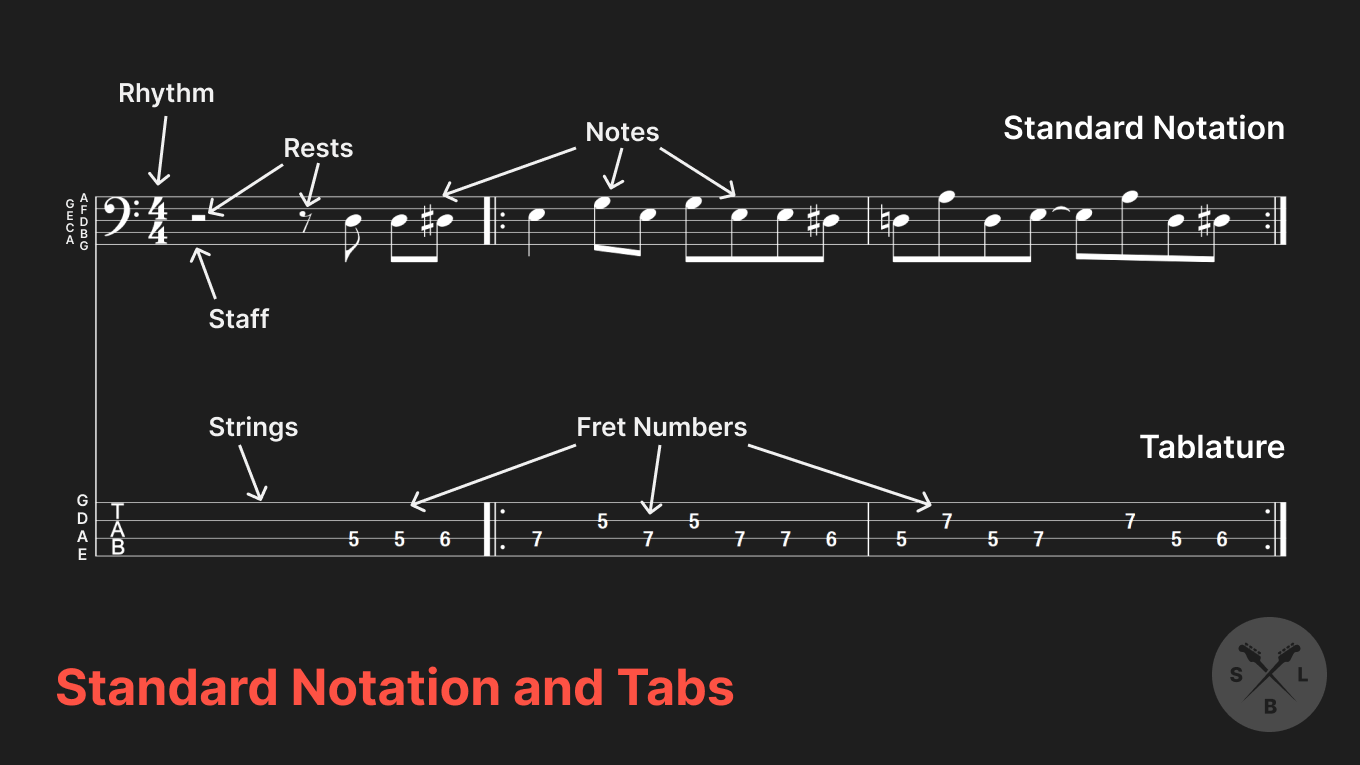
Note: We’ll reference these images throughout the article.
It’s important to note that bass tabs are different from regular guitar tabs.
Since bass guitars usually have four strings, this number is represented on bass tabs. And since guitars usually have six strings, the tabs will look slightly different.
What if you see five lines? That means the tabs are meant to be played on a five-string bass.
It’s just good to keep in mind so that you know whether or not you’re looking at a more advanced piece of tablature.
Now that we know what tabs are, let’s take a look at the various components that comprise a tab.
Strings in Bass Tabs
The strings are the lines that run horizontally across a tab. They represent the actual strings on your bass guitar.
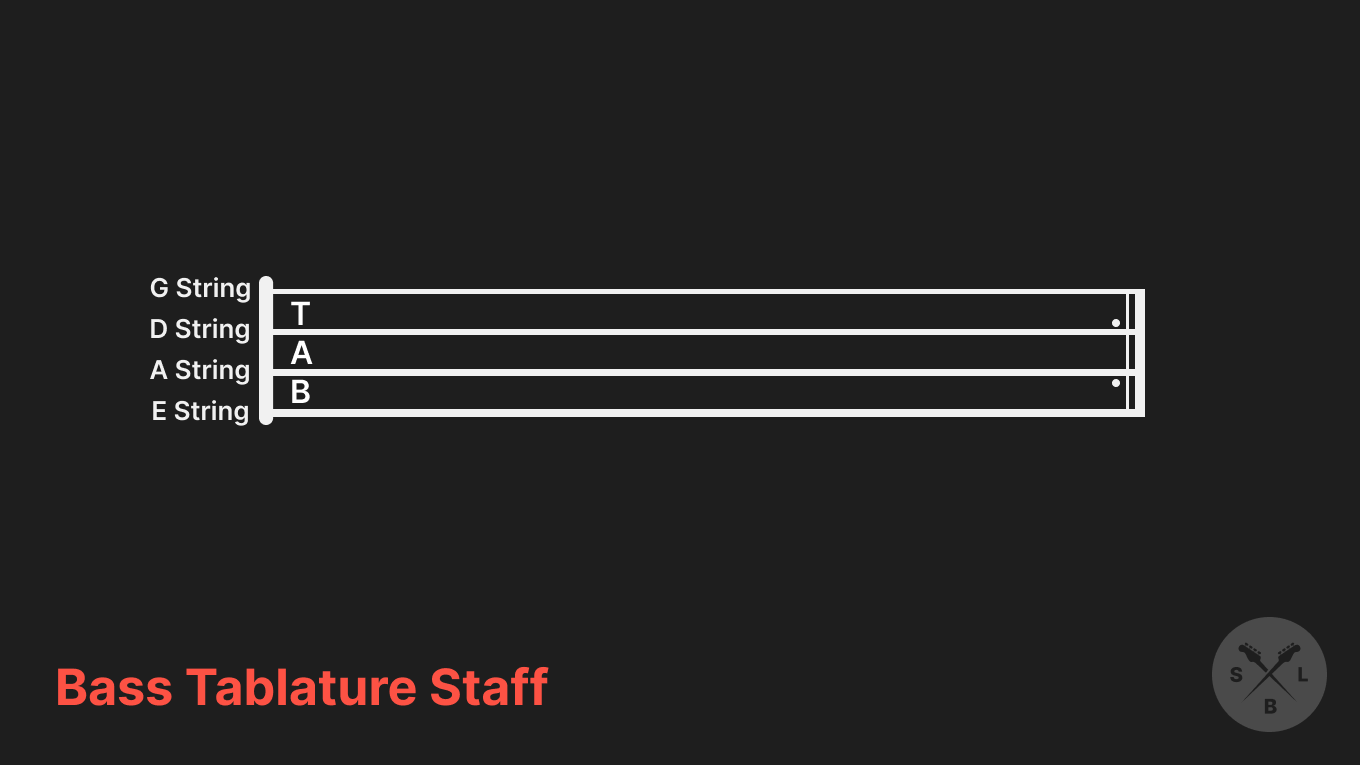
You can see them represented in the above image.
The order of the strings is as follows:
- The bottom line represents the E string
- The second line from the bottom represents the A string
- The third line from the bottom represents the D string
- The top line represents the G string
Fret Numbers in Bass Tabs
The numbers you see on a bass tab represent the fret numbers for each note.
Each number corresponds to a specific fret position and this lets you know where you should place the fingers of your fretting hand when you’re playing a song.
Bars in Bass Tabs
The vertical lines on a bass tab are the bars or measures. Bars are used to organize a group of musical notes that are determined by the time signature of the piece of music you’re playing.
Bars as a whole help you figure out the structure and rhythm of a song.
Rhythm in Bass Tabs
And finally, we have rhythm! The representation of rhythm in a bass tab can vary quite a bit – from not being represented at all to being represented by the corresponding musical notation.
There are three different ways to decipher the rhythm of a bass tab:
- Musical notation. This is a very clear system to indicate the length and duration of a note. It’s there that you’ll also find the time signature. For example, 4/4 lets you know that there are four quarter notes per measure.
- Tab count. Sometimes you’ll find that there is a tab count provided underneath the frets. For example, 1 + 2 + 3 + 4 + means an eighth note count.
- Freestyle. Other times, there’ll be no indication of rhythm – just the notes. You’ll have to listen to the song to figure it out yourself.
Bass Tab Symbols
We’ve covered the basics of what constitutes a tab – now let’s take a look at some of the special symbols you’ll come across.
These symbols can often be found at the beginning of the bass tab or on the lines of the tab. They tell you what types of techniques or articulations to apply to the strings in order to produce specific sounds.
Here are some of the most common ones:
Hammer-On
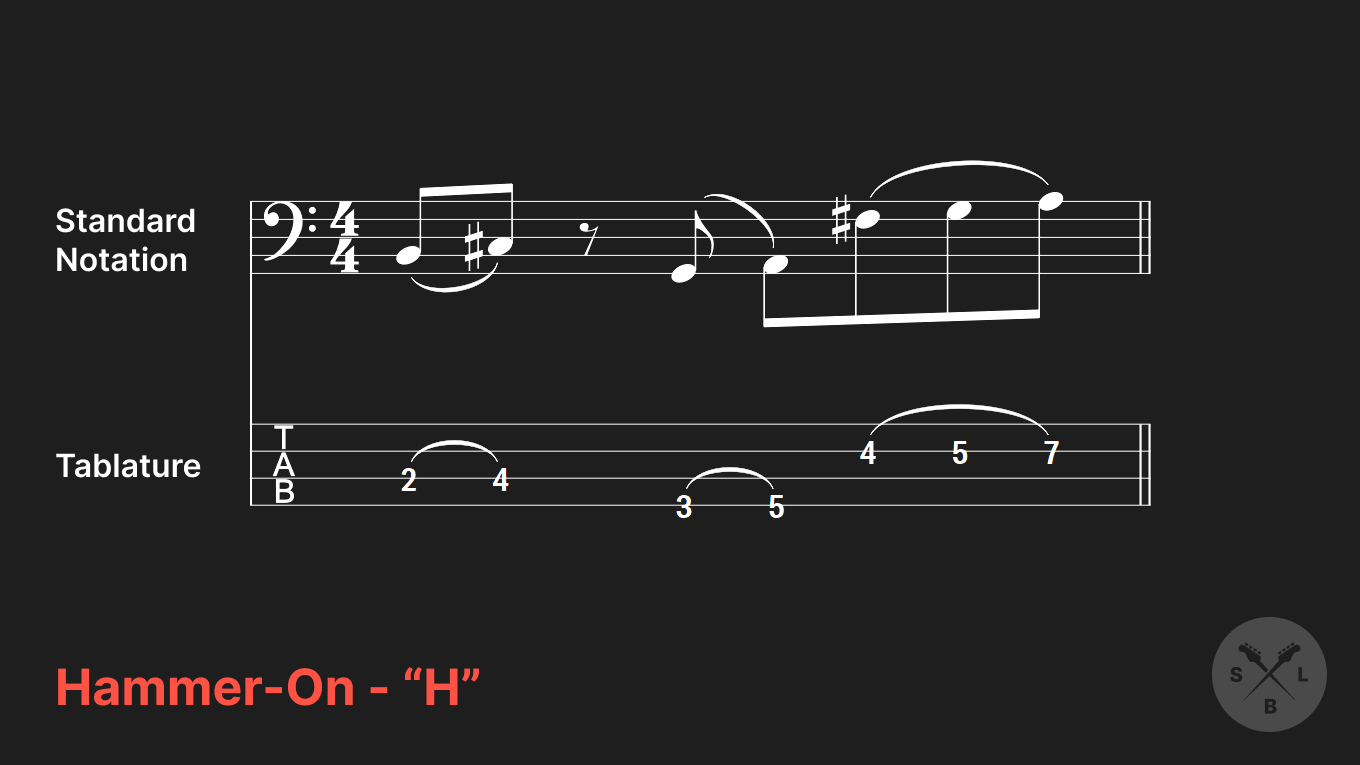
The hammer-on can add a lot of speed and smoothness to your playing. It’s represented by a slur line.
When you see this symbol, play the note not by plucking it, but by pressing the indicated finger using your fretting hand firmly and swiftly – or hammering it – on a different fret of a string that has just been played.
Hammer-ons are an articulation or a different way of producing the same notes. They help you play a lot faster when you need to, and give your plucking hand a break.
If you want to develop your hammer-on technique, have a look at my video for some killer exercises.
Pull-Off
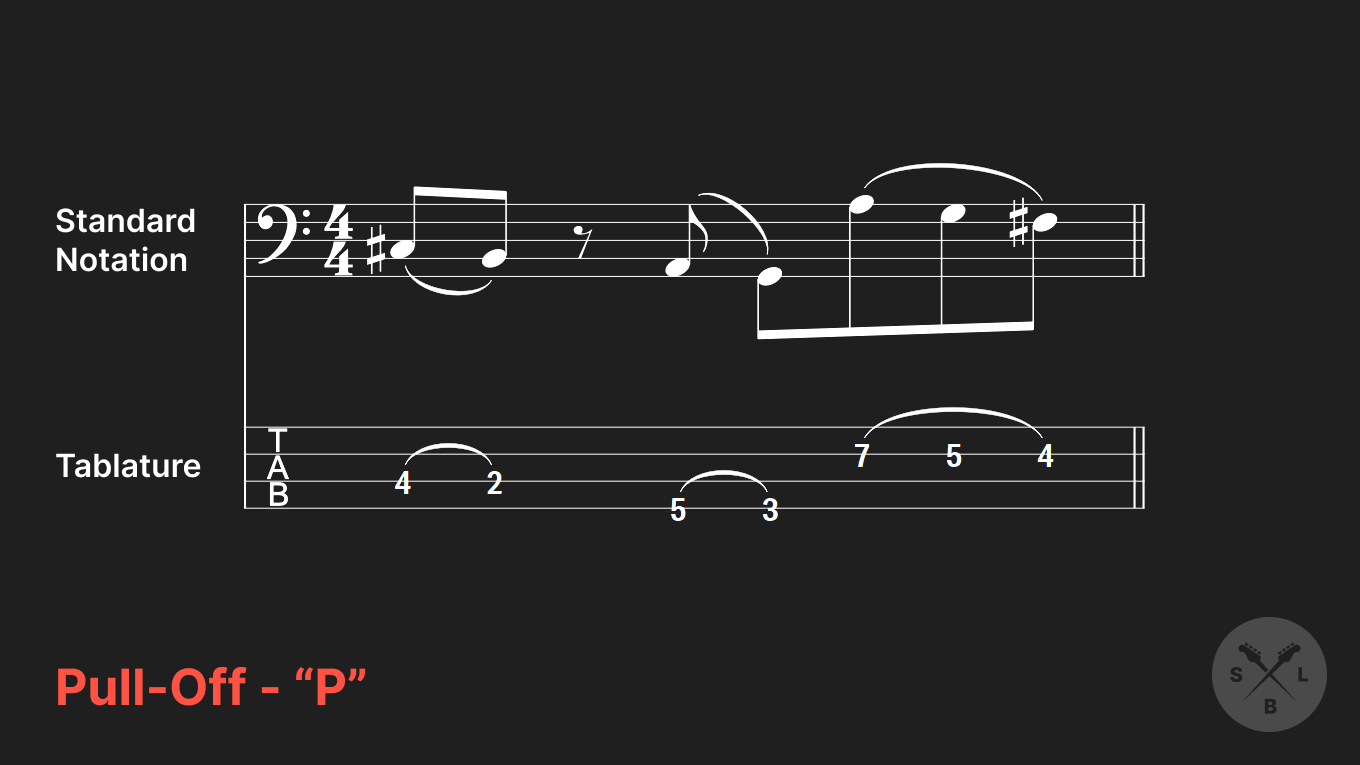
A pull-off, sometimes indicated with a “P,” is the opposite of a hammer-on. Instead of pressing down on a string, you release your finger from an already-ringing note on the same string without plucking again.
Similarly to hammer-ons, many bassists use pull-offs simply to add texture to their sound – but they’re also great for playing descending runs quickly and smoothly.
Slide Up - “/”
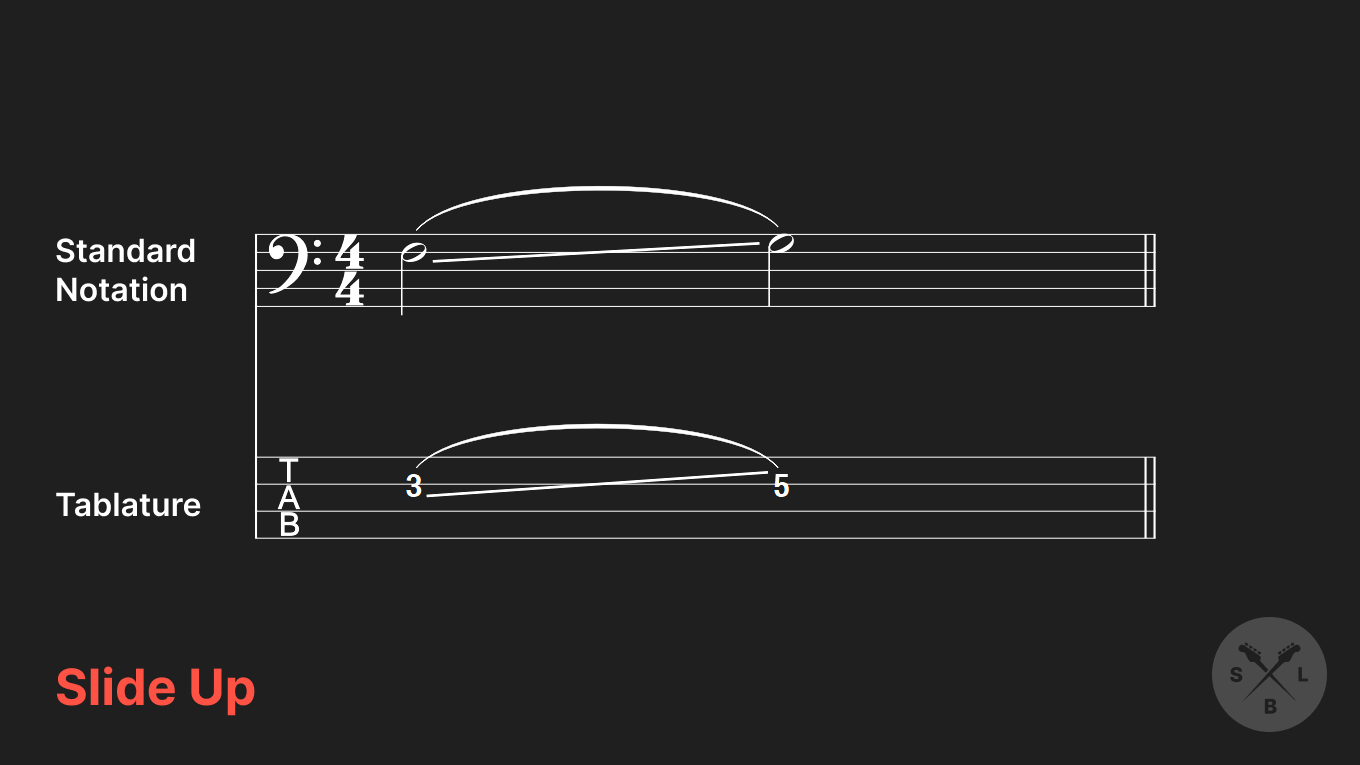
The slide up technique is indicated by an upward slanting line “/.”
To play one, simply place your finger on the start note then slide up to the desired end note without lifting it. In the above diagram, the slide occurs from the third fret to the fifth fret.
Slides up are often used to add flair to solos, fill in silent gaps, or add a bluesy sound.
Slide Down - “\”
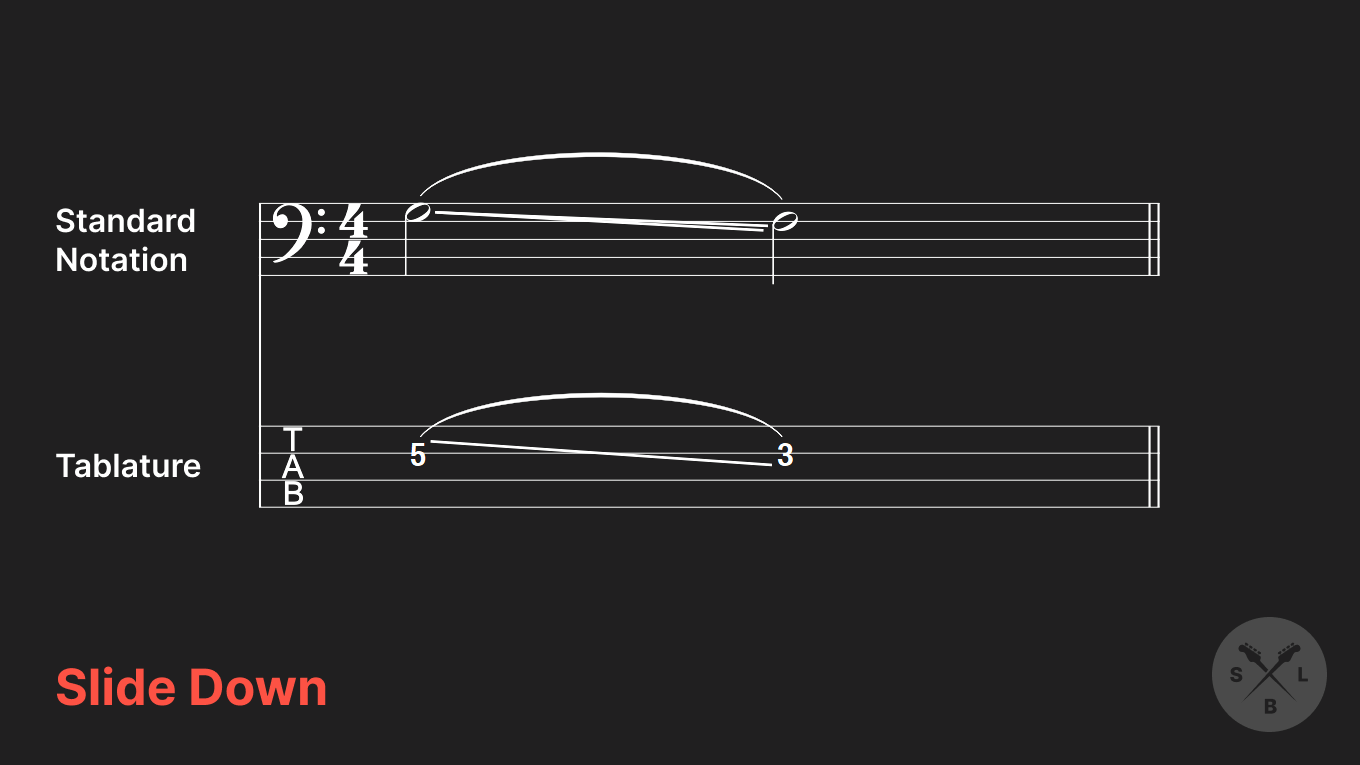
Slide downs are just like slide ups but in reverse. They’re indicated by a downward slanting line “\”.
To play one, place your finger on the start note and then slide down to the end note without lifting your finger. In the above diagram, the slide occurs from the fifth to the third fret.
Slide downs are used for similar reasons to slide ups–adding flair to solos, filling in gaps, and creating a bluesy sound.
Slap – “T”
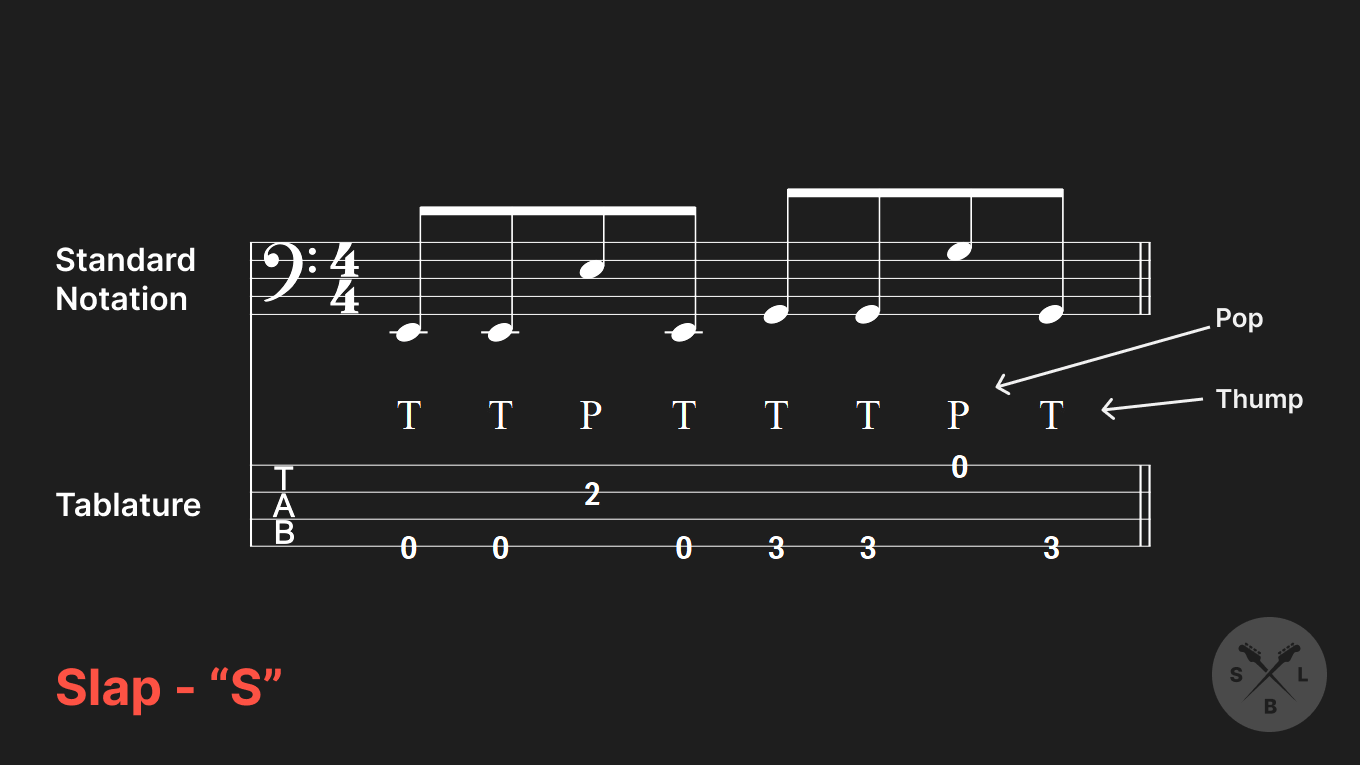
The slap technique creates that funky slapping sound bass musicians either love – or love to hate.
Indicated by the letter “T”, it involves using the thumb of your plucking hand to slap, or strike, the strings. You will see the letters “T” and “P”, which indicate when to slap with the thumb (T) or “pop” the string.
As you can imagine, many bass guitarists use the slap to add rhythm, energy, and percussive effects to their playing.
This technique gets a lot of flak, but it all comes down to quality control! Check out this video for my eight-step formula to get awesome at slap bass!
Bends
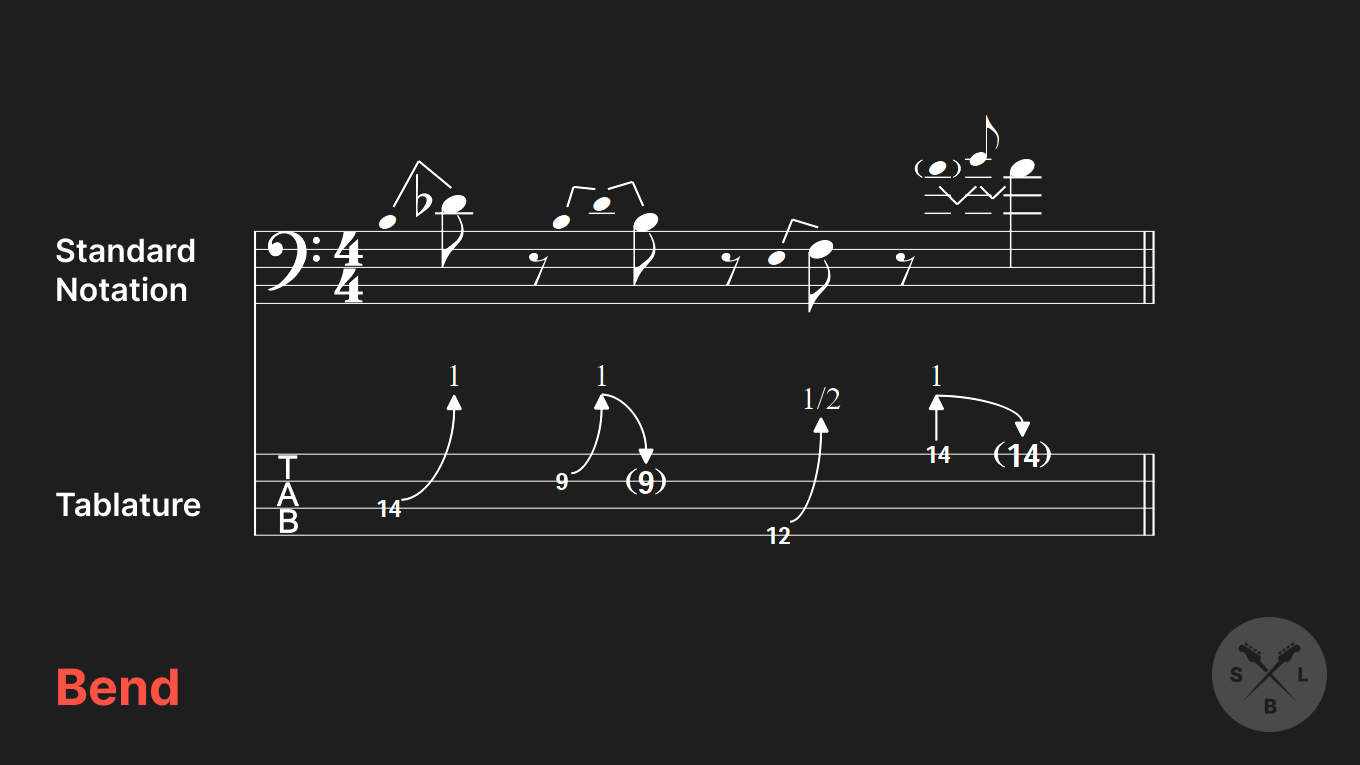
String bends are standard fare on electric guitar but they sound awesome on bass guitar too.
Bends are indicated with an upward or downward arrow.
String bends require you to push or pull the string sharply up or down on the fret, changing the pitch of the note being played.
½ or full signs are to indicate whether you bend up a half step or a whole step.
Bends add emotion to a song and can add a vocal-like quality to the music, allowing your strings to “sing” or “scream.”
Dead Note or Muted Hit – “x”
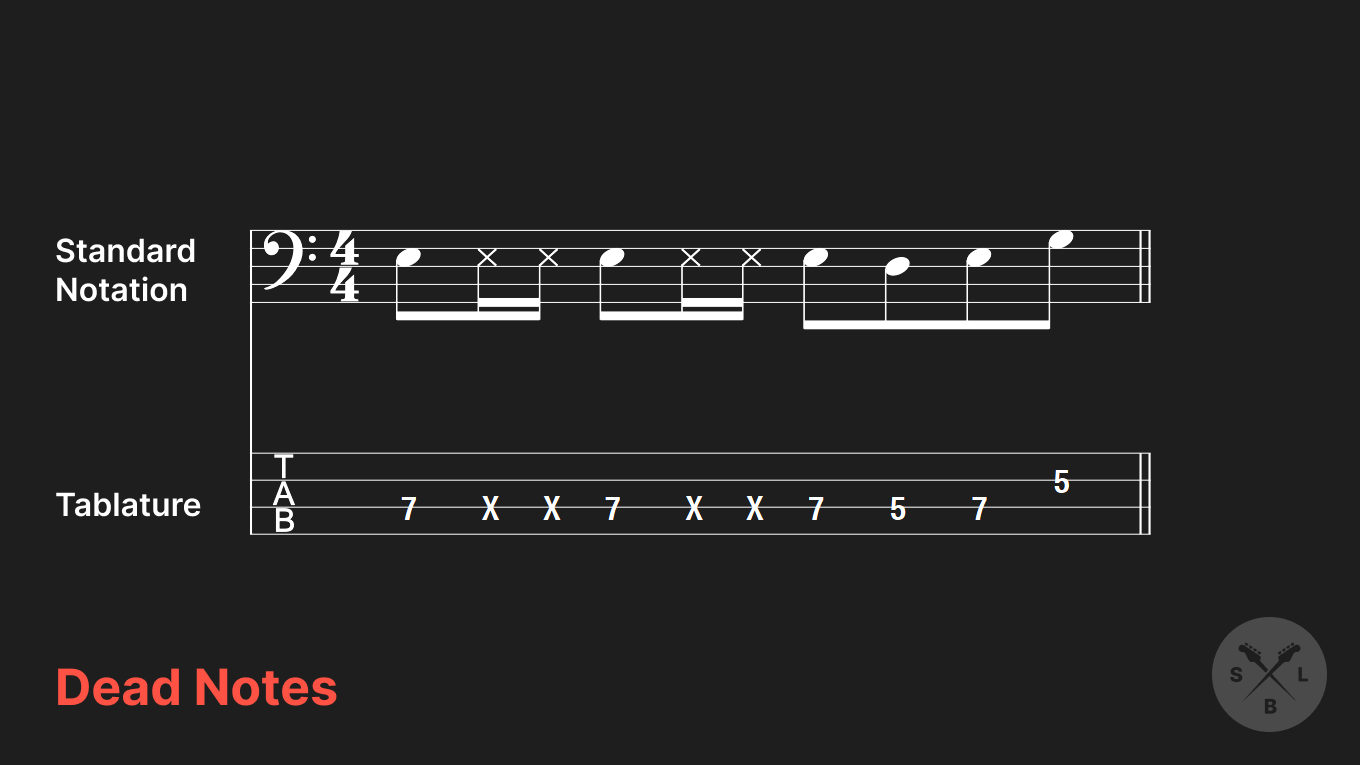
A dead note or muted hit is played by resting two fingers or more on a string and then striking it. Instead of a ringing tone, you hear a muted, percussive thumb instead.
A muted hit or a dead note is indicated by an “x”.
Many bassists use dead notes to add a percussive element to a bassline.
How to Read Everything Together
So now that we’ve gone through the bass tab lexicon, let’s take a step back and have a look at how it all fits together.
Reading bass tabs for the first time can feel quite daunting at first – and that’s totally okay! With a bit of practice, you’ll quickly find that it makes more and more sense.
When approaching a tab, start with the numbers of the lines – or the notes on the strings. Take it slow – work your way from one note to the next, one bar at a time.
Once you can play the basic notes, then take a look at the symbols. Keep this guide handy and use it as a reference if you can’t remember what all the symbols mean at first.
Don’t rush it! Whether it’s muting, bending, sliding, or slapping, take your time to fully understand what the tab is instructing you to do.
Once you’ve figured out the numbers and the symbols, apply your bass guitar knowledge and your feel for rhythm.
Often when learning how to read music, players can get quite bogged down in the theory and forget about all the knowledge they already have. So make sure to give yourself time and space to apply that knowledge.
Are You Ready to Translate Bass Tabs Into Music?
Now that you know how to read bass tabs, you’re ready to take your bass playing to the next level.
In that case, don’t waste another day of practice without these resources. Get your free bass toolkit today!