NEW Program Alert: The Groove Accelerator is OPEN for enrollment! Limited Time Only —Join Now
Bass Guitar Sheet Music: How to Read and Where to Find It
I remember the early days of learning how to play the bass and feeling intimidated by sheet music—and for good reason!
There were so many rules and symbols I had trouble nailing down. But then there were all these super cool musicians glancing at some sheet music and jamming away.
I wanted to be part of it!
Thankfully, sheet music isn’t as tricky as it looks.
So, if you find yourself where I was, wanting to learn how to read sheet music but not knowing where to begin, don’t worry.
Today, I’m taking you through the basics of bass guitar sheet music.
How Is Sheet Music Different From Bass Tabs?
This is a great question that a lot of my students have.
That’s because sheet music and bass tabs (also known as tablature) serve the same purpose: they show you how to read and play music.
The difference is how they do this.
Sheet music uses staff notation—which I’ll get into in the next section—to represent pitches, rhythms, dynamics, and articulations through a series of notes and symbols on a five-line staff.
The notes and symbols used in sheet music give you all the information you need to play a song accurately. The cool thing about sheet music is that it’s standardized. This means it’s what all musicians use when they talk about sheet music, regardless of their instrument!
Bass tabs, on the other hand, are an instrument-specific notation system. Tabs use numbers to show which fret to play on each string.
Tabs are generally easier to learn and use, especially if you’re starting.
The downside to tabs is that they lack certain details. Because of their simplicity, you most likely won’t get comprehensive rhythmic information. This can make it difficult to understand how to play a song rhythmically.
Some bass players prefer sheet music over tabs because tabs lack all the information needed to play a song. That’s why learning to read sheet music can be a great choice, even though tabs are still helpful.
How to Read Bass Guitar Sheet Music
Reading sheet music may seem challenging at first. But with some practice, you can master it in no time.
Let’s go through the basics of what you can find in sheet music.
1. Understanding the Staff
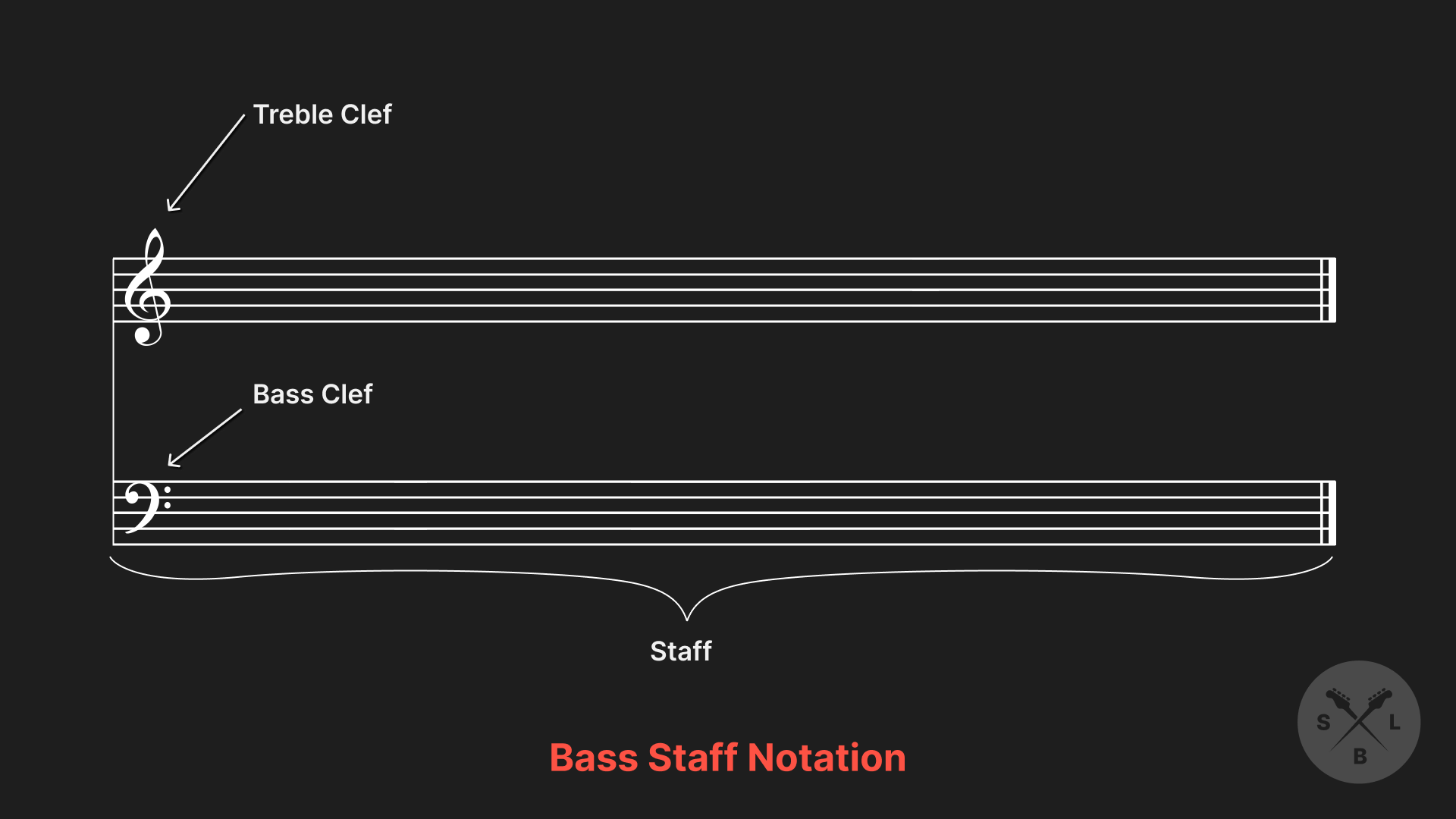
The staff has five horizontal lines and four spaces. Each of these represents a specific note.
At the beginning of the staff, you’ll find a bass clef. The bass clef appears on all bass guitar sheet music. The bass clef determines the pitch of the notes written on the staff. This ensures that the notes fall within the bass’s range.
2. Notes on the Staff
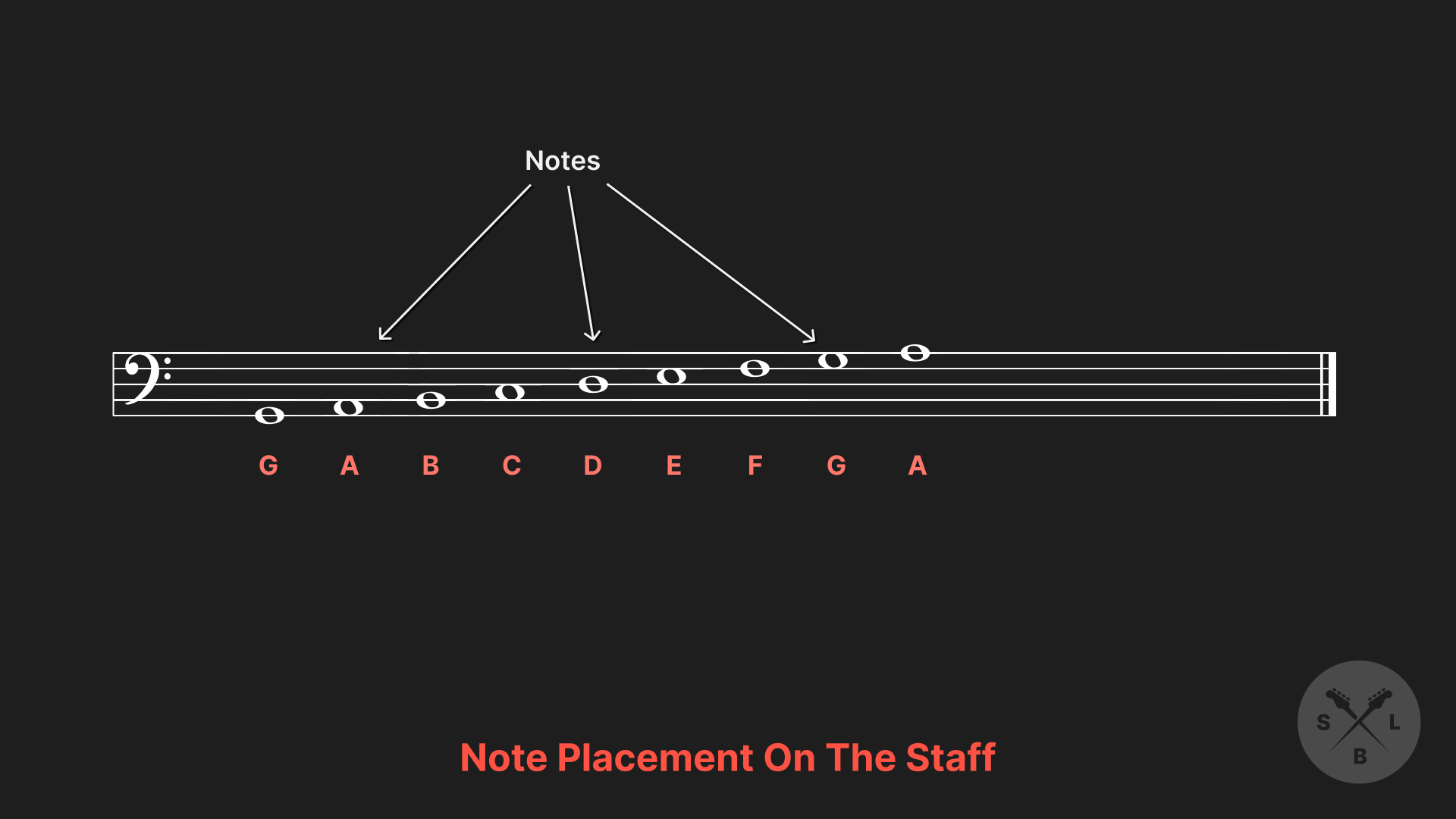
Music notes are written on the lines and spaces of the staff.
The notes on the lines from bottom to top are G, B, D, F, and A. The notes in the spaces from bottom to top are A, C, E, and G.
Some bass players use phrases to remember the notes on the lines and spaces. Two popular ones are “Grizzly Bears Do Fine Always” for lines and “All Cows Eat Grass” for spaces
3. Ledger Lines
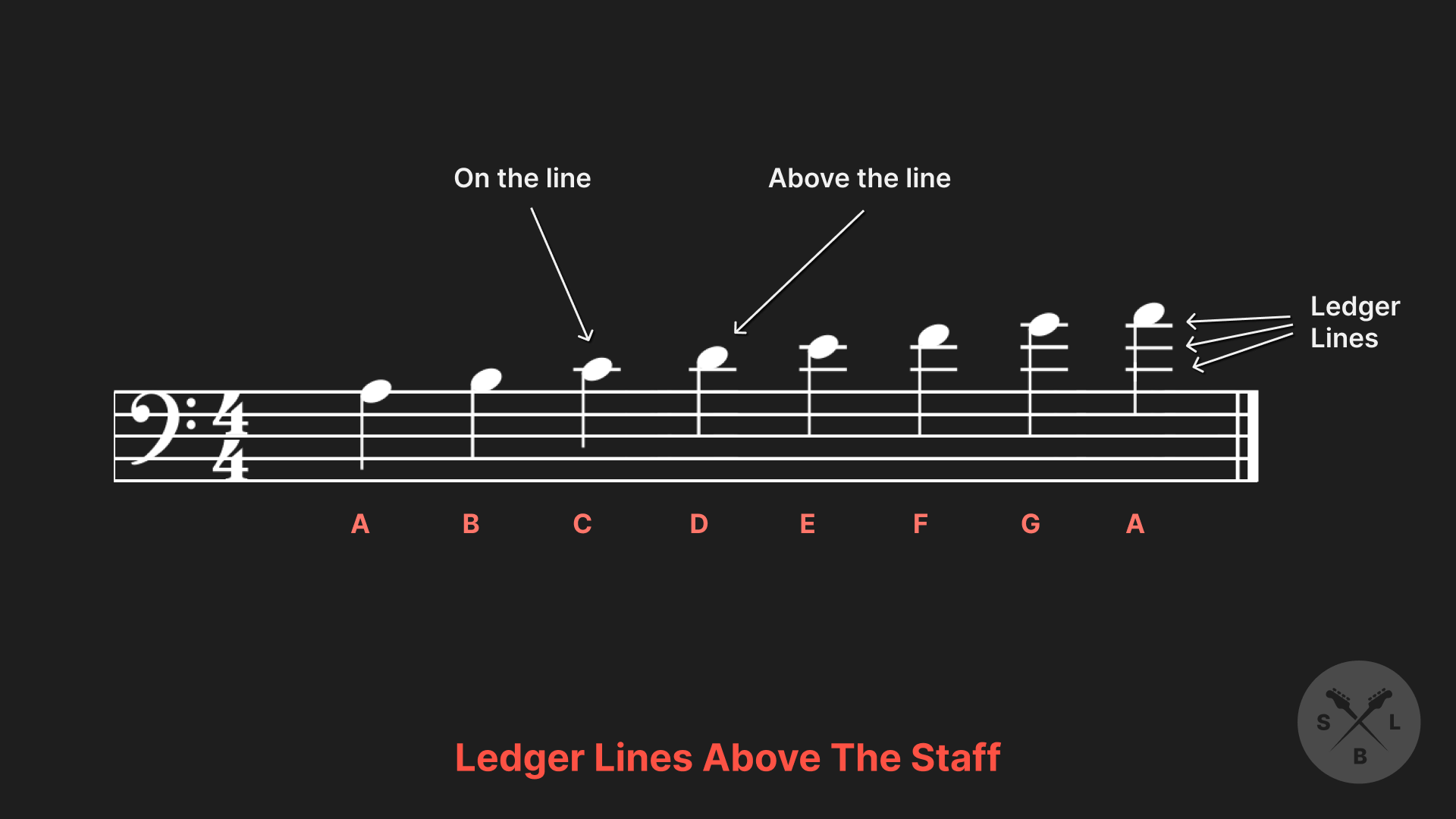
Sometimes, notes fall above or below the staff. When this happens, ledger lines save the day.
Ledger lines are short lines that extend the staff in either direction.
The first ledger line below the staff represents an E, while the first ledger line above the staff represents a high C.
4. Note Durations
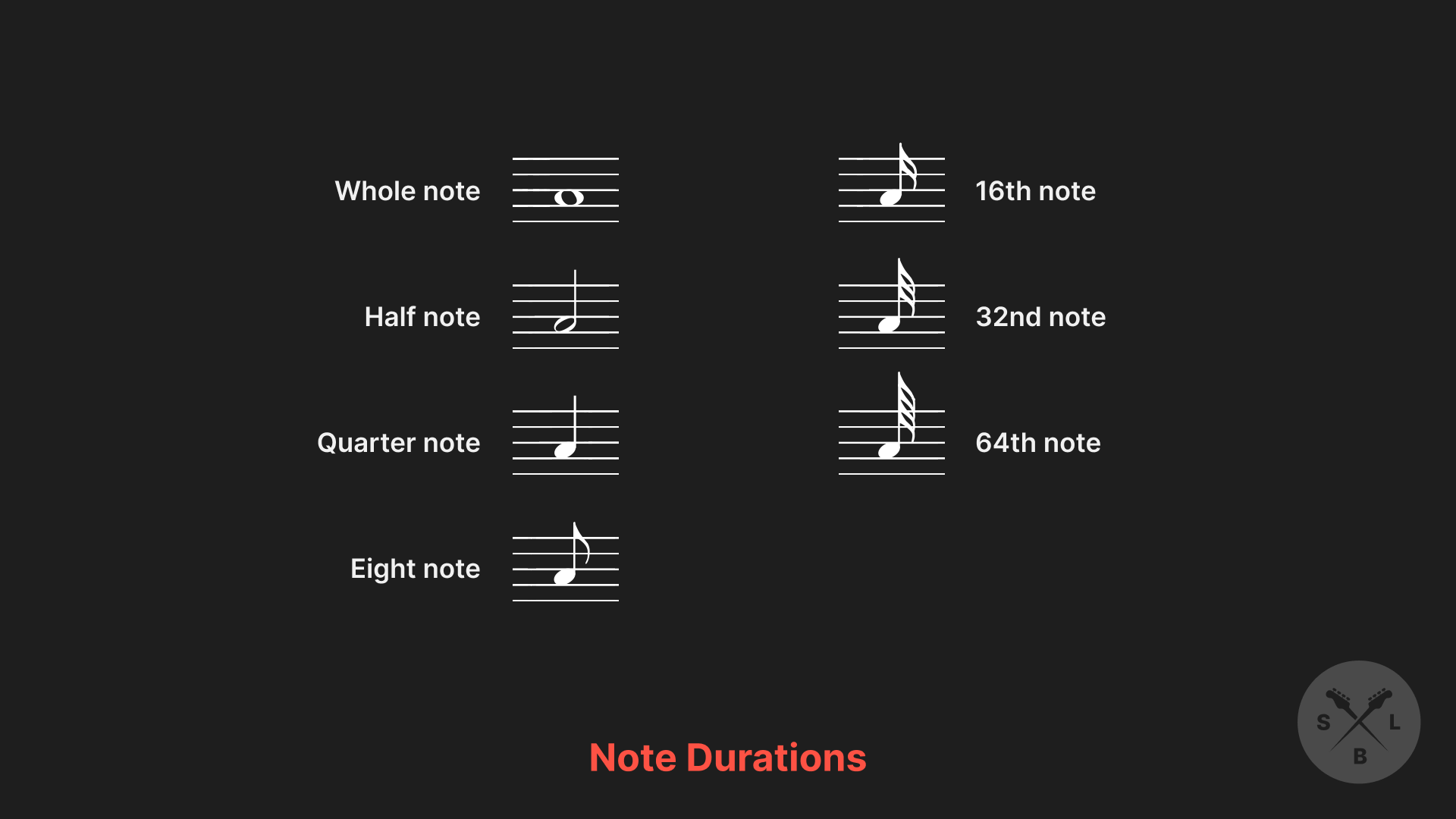
Note durations tell you how long you should hold a note while you play. They come in different shapes to indicate their durations. The different kinds of note durations are:
- Whole Note: Hold for four beats
- Half Note: Hold for two beats
- Quarter Note: Hold for one beat
- Eighth Notes: Hold for half a beat
- Sixteenth Note: Hold for a quarter of a beat
5. Time Signatures
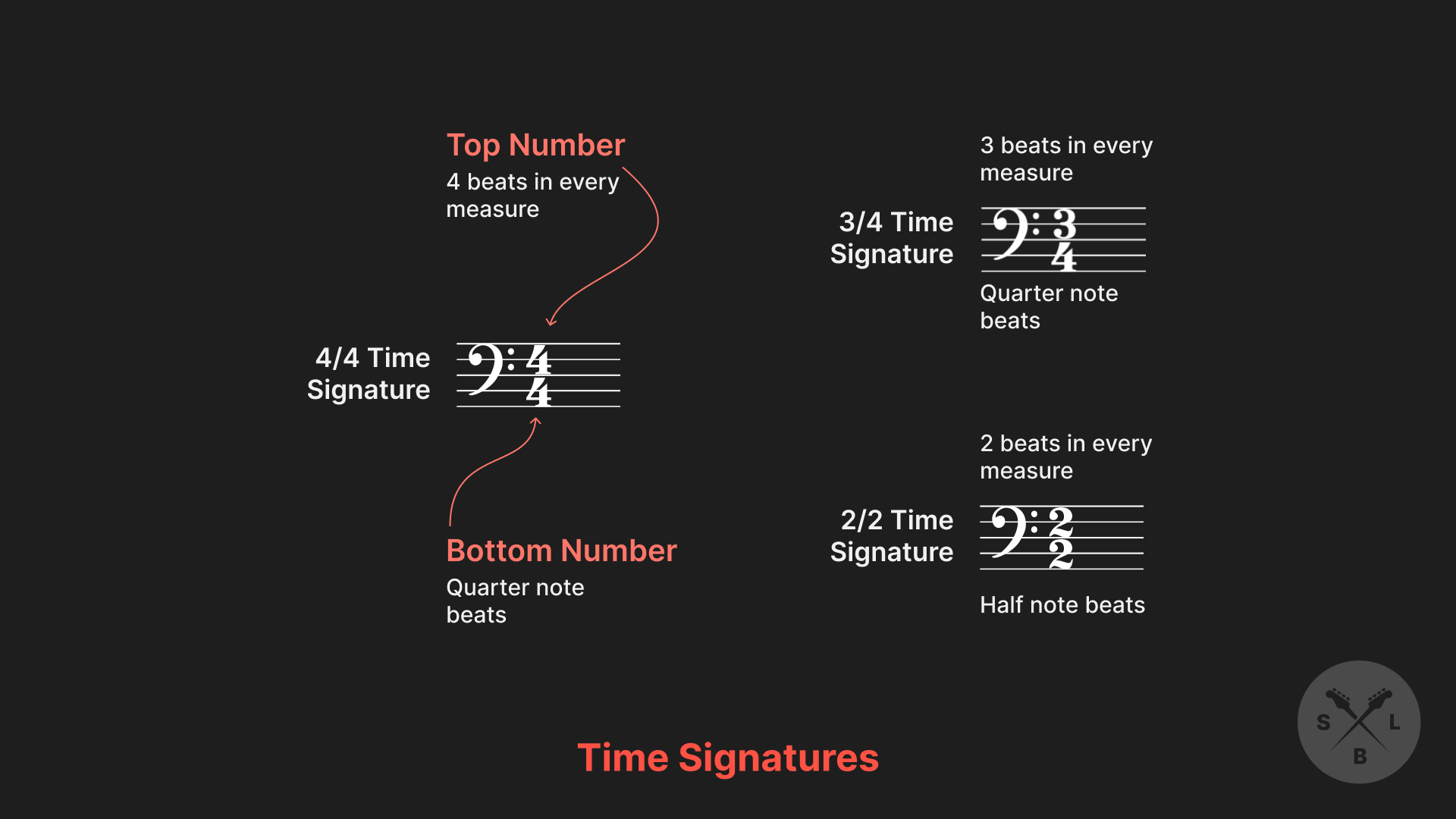
Time signatures appear at the beginning of a piece. They do two things: indicate the number of beats per measure and what type of beats they are.
When you look at the time signature, there are two numbers, one on top of the other. The top number tells you the beats per measure, while the bottom number identifies the type of beat.
Common time signatures include 4/4 (four-quarter note beats per measure), 3/4 (three-quarter note beats per measure), and 6/8 (six-eighth note beats per measure).
6. Rests
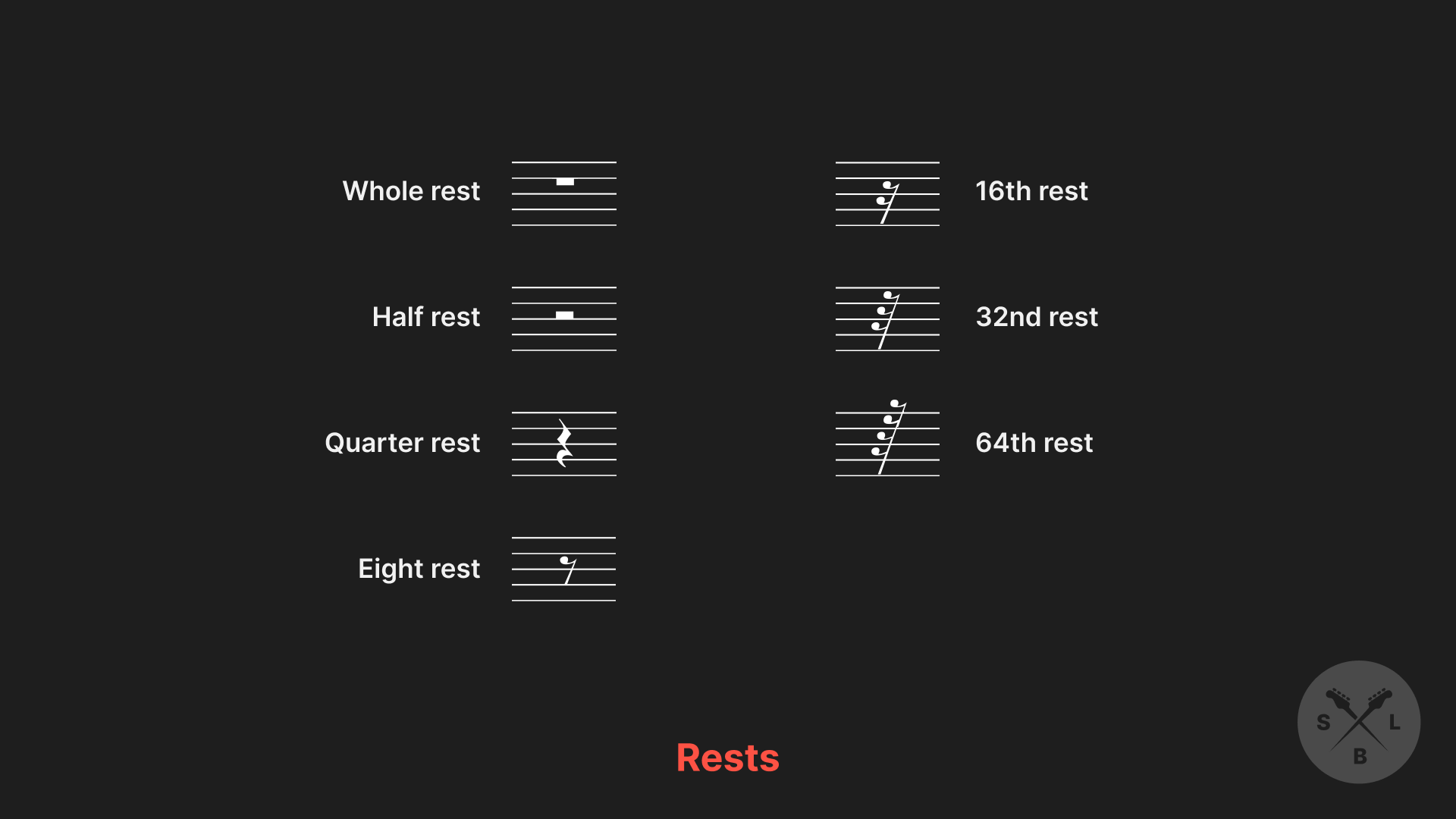
Rests tell you when to pause while playing.
Like notes, rests have different durations. A rest’s duration is equal to the corresponding note value. In other words:
- Whole Rest: Rest for four beats
- Half Rest: Rest for two beats
- Quarter Rest: Rest for one beat
- Eighth Rest: Rest for half a beat
7. Dynamics
Dynamics refers to how quiet or loud the music is.
The common dynamic markings in sheet music are:
- Pianissimo (pp): Very quiet
- Piano (p): Soft
- Mezzo-piano (mp): Medium quiet
- Mezzo (m): Medium
- Mezzo-forte (mf): Medium loud
- Forte (f): Loud
- Fortissimo (ff): Very loud
Sheet music also uses two words—crescendo and decrescendo—to tell you when to increase or decrease the volume gradually. Crescendo tells you to get louder, while decrescendo tells you to get quieter.
8. Articulations
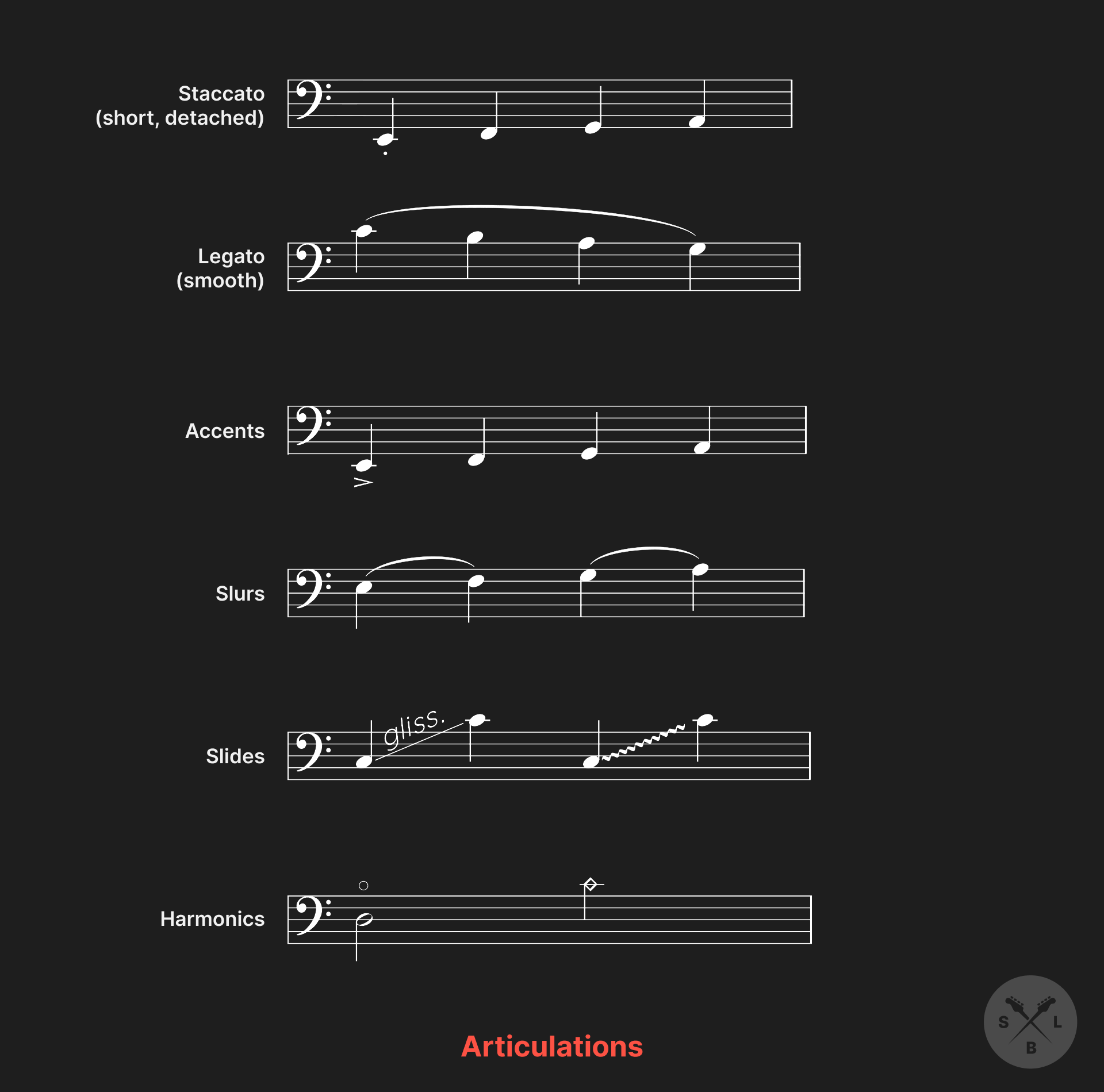
Articulations describe how you should play a note. This is what gives the music a certain kind of feel.
- Staccato: This tells you to play a short, detached note. If there’s a dot above or below the note, it’s staccato.
- Legato: this indicates that you have to play smooth, connected notes. Legato notes have a curved line above or below the note.
- Accents: If a song requires emphasis on a particular note, that’s where accents come in. Notes with accents have a greater-than symbol above or below them.
- Slurs: Slurs connect two or more notes of different pitches, indicating they should be played smoothly and connectedly. They are visually represented by a curved line above or below the notes.
- Slides: Slides involve smoothly transitioning from one note to another, either subtly (portamento) or rapidly (glissando). They are represented by a straight or wavy line between the starting and ending notes.
- Harmonics: Harmonics produce bell-like overtones by lightly touching a string or air column at specific points. They’re written as small circles or diamond-shaped noteheads above the staff.
To learn more about articulation, check out my article on leveling up your bass lines!
9. Positioning on the Bass
Sometimes, songs need to get specific with where your fretting hand needs to be. Position markers help with that.
Position markers indicate where you should place your fretting hand on the fretboard to play the notes efficiently. The idea is that your fretting hand anchors at a particular fret. This lets you comfortably reach notes within a certain range.
Positions are typically numbered based on the fret where the index finger is placed. For example:
- First Position: The index finger is at the first fret.
- Second Position: The index finger is at the second fret.
- Third Position: The index finger is at the third fret.
And so on.
Roman numerals appear above the staff to represent position markers.
It can help to look at a bass guitar fretboard chart to visualize the different positions.
10. Putting It All Together
Now that I’ve covered the basics let’s put it all together!
When you get the sheet music, start by identifying the notes on the staff and the duration of each note. Keep an eye out for any position markers to determine where you should play the notes.
Next, review the time signature, rests, dynamics, and articulations. If possible, listen to the song as you review the sheet music. This will give you an idea of what it should sound like.
From there, start slow and begin to work through the song. Just like daily finger exercises build dexterity, practicing playing with sheet music regularly builds your skills and confidence.
Where to Find Bass Guitar Sheet Music
Learning how to read sheet music is just the first step.
The next step is to find some!
Finding quality sheet music is essential for improving your skills and expanding the list of songs you can play.
Here are a couple of resources to get you started:
1. MuseScore
MuseScore has a massive collection of free and premium bass guitar sheet music. You can check out a variety of genres and styles on the site.
You can even listen to the song and play along with the scores to practice:
2. Free Bass Transcriptions
Free Bass Transcriptions is exactly how it sounds! The website offers over 200 free transcriptions of bass sheet music and a wide selection of popular songs.
It’s a great resource for finding new songs without breaking the bank.
3. A Local Music Store
If you’re looking for a certain song and just can’t find it, I highly recommend visiting a local music store if there’s one near you. They can usually look up sheet music for the song and order it for you. There might be a wait time if they can’t directly print it, but it helps in a pinch.
You can even check out their bass guitar selection while you’re there if you’re looking for a new bass.
From Sheet Music to Shredding
Learning how to read sheet music is a great skill to have!
Sheet music opens up a whole world of possibilities with bass playing. Not only do you get to learn new songs, but it makes jamming out with other musicians that much easier.
Everyone’s on the same page, and the music can just flow. It’s community building.
And if you want to expand your community, I’ve got just the thing.
The SBL Academy has a passionate community of bassists just like you! Plus, it’s got hours upon hours of courses, taught by some of the best bassists on the planet. And, when you sign up, you get a customized roadmap to help you learn the bass faster than ever.
Try the SBL Academy free for 14 days!