
NEW Program Alert: The Groove Accelerator is OPEN for enrollment! Limited Time Only —Join Now
How to Easily Memorize ALL the Notes on the Bass Fingerboard
Figuring out where notes are on the fingerboard is pretty easy—there are countless examples all over the internet!
The real work comes when you try to memorize the notes on the fingerboard!
In this lesson, I'm going to show you a super easy-to-understand exercise that's going to help you memorize all the notes over the entire fingerboard systematically, and bring you one step closer to mastering your entire fretboard.
Now I know at first glance it might look like there are countless notes. But the truth is that there are only a handful of bass note names you need to remember—and I’m going to show you how with the following techniques.
Originally published on January 18th, 2017, this post was updated and republished on November 20th, 2023.
1. The Circle of Fifths: Your Musical Compass
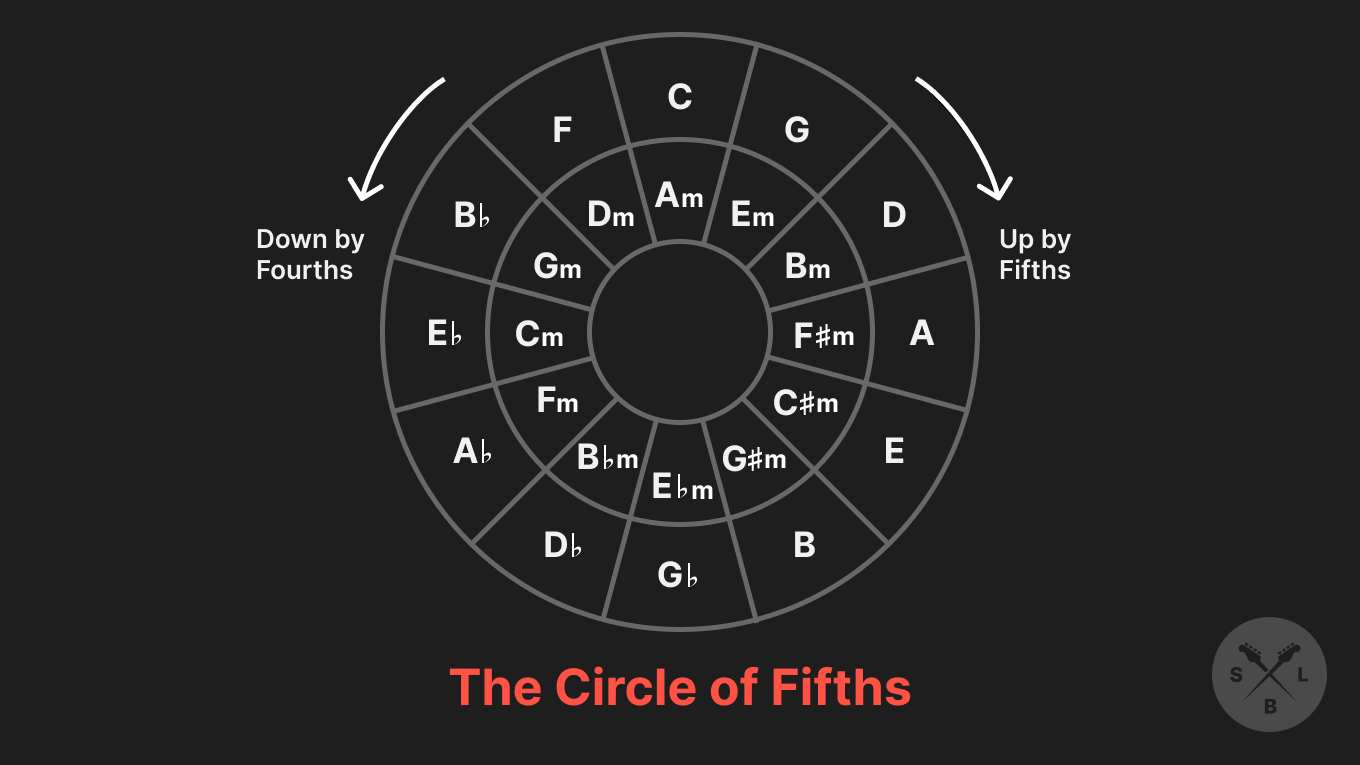
The Circle of Fifths is a way of organizing the 12 musical pitches in a sequence that will help you understand and memorize the 24 major and minor keys used in Western music.
It’s a music theory gem, and we're using it to break away from the traditional sequential learning approach.
The Circle of Fifths consists of the first twelve notes of the fretboard – C, F, B flat, E flat, A flat, D flat, G flat, B, E, A, D, G, C.
Here’s how the exercise works:
- Identify the first note in our sequence (it’s C)
- Find each C note from the 1st to the 12th fret – there’ll be one on every string
- Play eight notes in each position
- Next, move on to the next note (F) and do the same thing – identify where the F note is on each string, and play eight notes in each position
- Continue this exercise for the entire Circle of Fifths
What really helps me is saying the notes out loud as you work through this exercise to really hammer the point home!
2. Ascending and Descending
Now the above exercise was just us ascending through the whole sequence. And now that you’ve mastered the ascending sequence, let's spice things up.
Play the notes you just played in both ascending and descending order. Essentially, you’re playing the exercise in reverse order!
It's a bit trickier, but trust me, it's the secret sauce to unlocking the full potential of the bass neck.
3. Chunking: Making it Manageable
Learning all the notes at once can be overwhelming.
Here's the trick—chunk it. Break down the twelve notes into manageable groups.
Take, for instance, the first three or four notes. Instead of overwhelming yourself with the entire Circle of Fifths, focus on C, F, B flat, and E flat.
Practice these until they become second nature!
Fingerboard: Check! What’s Next?
Now that you know all of the notes on the fingerboard, it’s time to take your bass practice to the next level. Join us at the SBL Academy, where you’ll get a tailored roadmap to help you take your bass playing to the next level.