
NEW Program Alert: The Groove Accelerator is OPEN for enrollment! Limited Time Only —Join Now
How to Master Your Entire Bass Fretboard in 7 Steps
Imagine this – picking up your bass to tease out a bass line, and your fingers effortlessly finding every single note without an ounce of hesitation.
This isn’t a fantasy – with a few simple steps and a bit of practice, you can master the entire bass fretboard.
Beyond simply knowing the notes, this will also help you organize things like key signatures and chord changes on the fly.
Once you have this knowledge, the doors to bass mastery will be blown wide open!
Originally published in 2021, this post was updated and republished on July 11th, 2023.
Things To Know Before You Start
There are just two things we need to run through quickly before we get stuck into learning the bass fretboard:
The Circle of Fifths
The Circle of Fifths is a framework that was –believe it or not– originally developed by the mathematician Pythagoras!
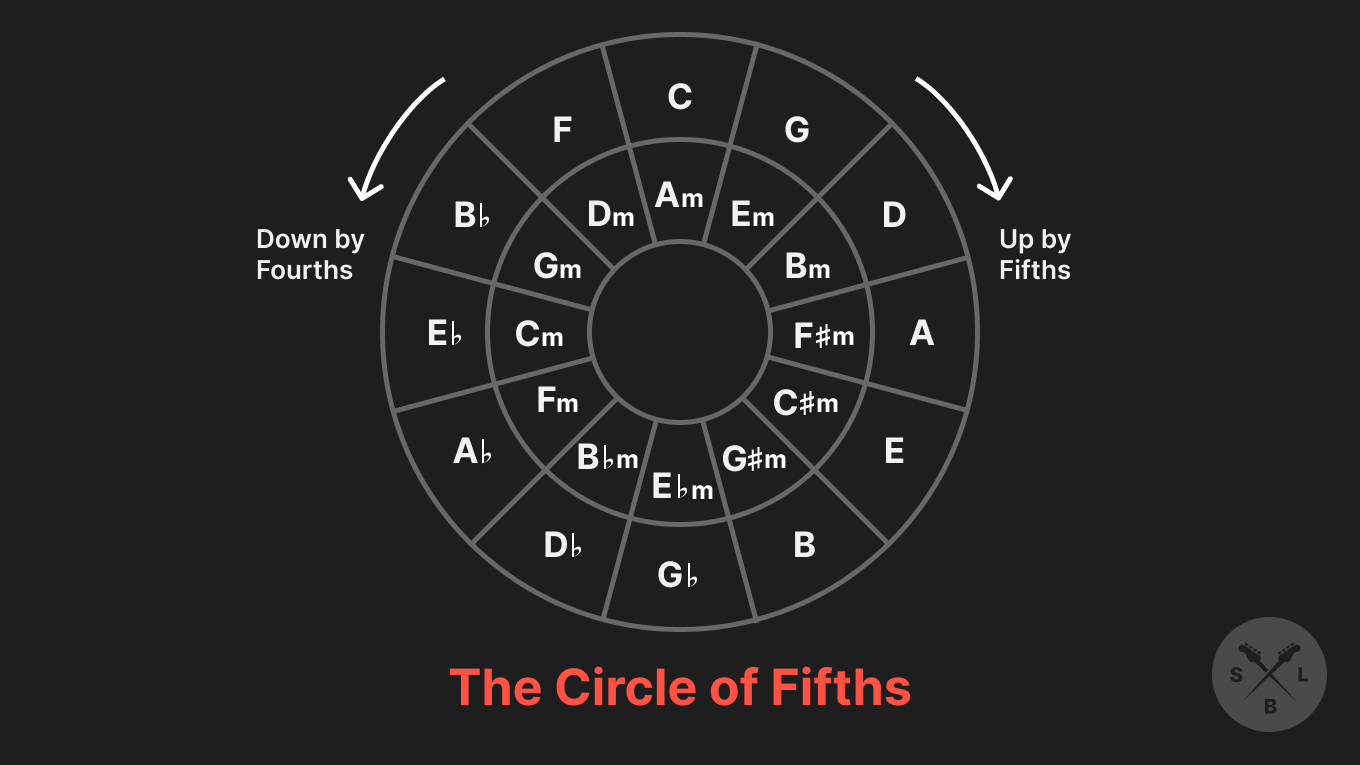
You might recognize this diagram from school – it kind of looks like a clock and includes all 12 musical notes read anticlockwise. Some people also refer to it as the Circle of Fourths (which is the same thing but in reverse order.)
This chart is the framework for our seven-step process, and you’ll be referencing it often. If you can print it out, then I definitely recommend doing so and sticking it somewhere where you’ll see it every day.
Twelve Notes
Here’s a not-so-secret that you need to know – in Western music, there are only 12 notes that exist on the bass guitar (or any instrument for that matter).
Each of those notes only exists once on each string, below the 12th fret.
Keep this in mind as we work our way through the seven-step process below.
Learning the Bass Fretboard in 7 Steps
Alright, so now you’re armed with the Circle of Fifths and you have the 12 notes in mind, let’s dive into my 7-step process for getting intimate with the bass fretboard!
Step 1: Get Familiar With the Exercise
First thing first – it’s important to get familiar with the exercise that we’ll be covering for the rest of this article.
We’ll start by picking up the bass and taking a look at the note of C. Do this by finding and playing the C note on all the strings below the 12th fret.
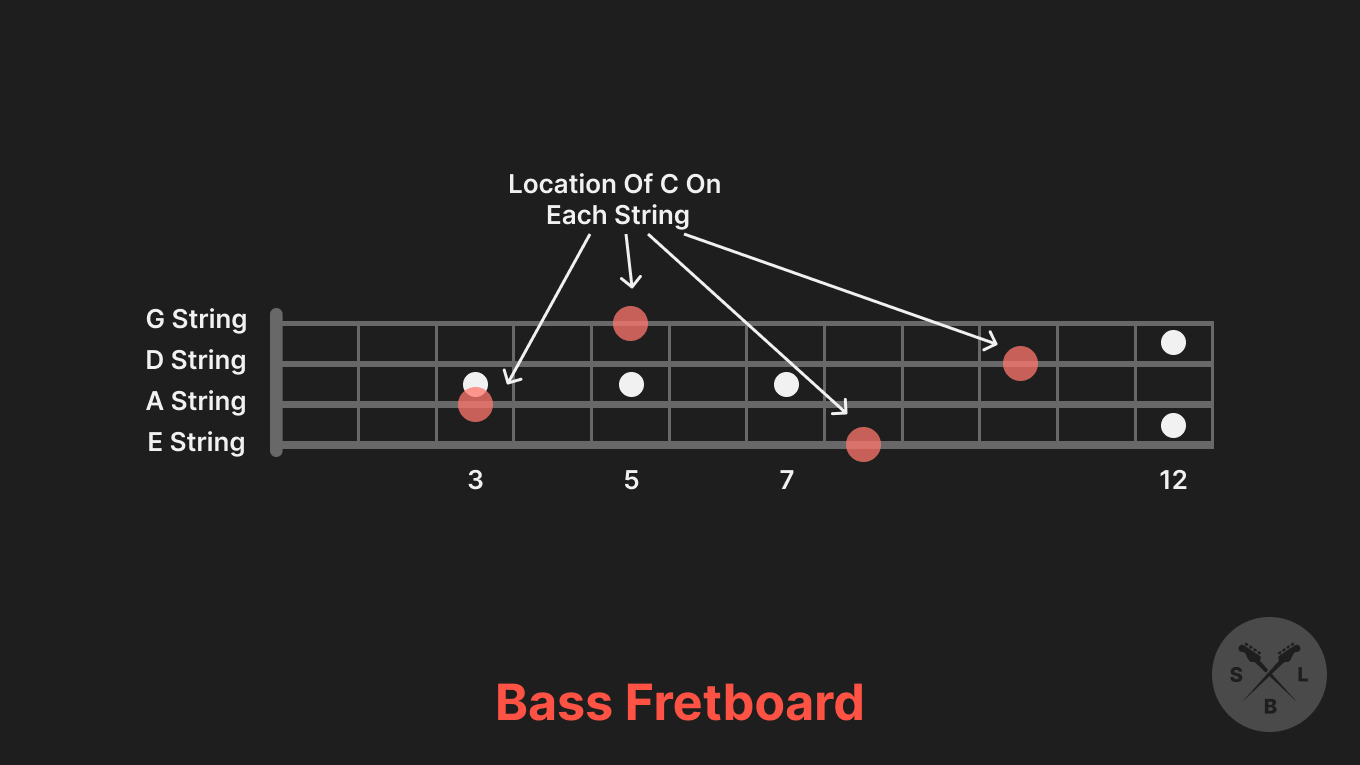
Finding these notes does not mean memorizing a pattern of where they occur – there are so many patterns that it’s just not feasible!
But by running these exercises, you’ll start to develop a memory of where these notes are naturally.
Try doing this with a few different notes like G and F. Oh, and don’t use a metronome either – just try and casually run through this exercise so you have a general idea of what’s to come.
Step 2: Break the Circle of Fifths Into Groups of 3
Remember the Circle of Fifths I spoke about above?
In this next step, we’re going to be breaking it into four groups of three. Each group will contain the following notes:
- Group 1: C, F, and B flat
- Group 2: E flat, A flat, and D flat
- Group 3: G flat, B, and E
- Group 4: A, D, and G
Starting with the first group, run the exercise that we covered in Step 1 note–by–note as many times as you need until you’re comfortable with the position of the notes.
This means finding all of the C notes, then the F notes, then the B flat notes.
Here’s the deal – this could take you a day to learn, or it could take you a week or more. We all learn at different speeds, but it’s important to take your time and get comfortable with those first three notes before you even think about moving on to the next group.
Once you’ve nailed that first group, move on to Group 2 – E flat, A flat, and D flat – and run the same exercise. Once you’ve got those down, move on to the next three notes. You see where this is going.
Even if this feels tedious, trust me, it’s the best exercise I’ve ever used to actually learn the notes, fingerboard, and stuff that’s going to make a big difference!
Step 3: Introduce the Metronome
This step is pretty much the same as Step 2 but with the added gentle pressure of the metronome.
Don’t expect to be playing like Dragonforce off the bat – it’s important to start slow.
Set the metronome to 40 BPM and start with all of the C notes, then move on to F, then B flat.
Work your way anticlockwise and play each note below the 12th fret in the rhythm of the metronome until you’ve completed each group.
Remember, do this one group at a time. Once you feel comfortable that you know all of the positions of the notes in a group, only then do you move on to the next set of three.
I get that this is a slow burn, but it will really help you learn the fingerboard!
Step 4: Run the Entire Circle
This next step is the same as step 3, except that you run the entire exercise around the Circle of Fifths without pausing after each group.
So start with C, play all of the C notes below the 12th fret, then move on to F, then B flat, then E flat, etc.
Take your time and make sure you nail this before moving on.
Step 5: Break the Circle Into Pairs
Now that you know the circle quite intimately, we’re going to break them up and see if we can work with them in a different way.
Divide the groups into pairs of two and, using the metronome at 40 BPM, play up the fretboard for one note and down the fretboard for the other note in each pair. It’ll look like this:
- Pair 1: up C and down F
- Pair 2: up B flat and down E flat
- Pair 3: up A flat and down D flat
- Pair 4: up G flat and down B
- Pair 5: up E and down A
- Pair 6: up D and down G
Repeat each pair until you feel comfortable enough to move on to the next one.
Step 6: The Entire Circle of Fifths
This step is pretty similar to the previous step, but now we’re going to tackle the entire Circle of Fifths without stopping. This means we’ll be running the circle in pairs – one up and one down for each pair – but then immediately moving on to the next pair until we’ve run the entire circle.
Again, do this as many times as you need to in order to feel totally comfortable with everything.
Step 7: Increase the Speed
For the final step we’ll be increasing the speed of the metronome. We’ve been slowly building our way up to it, but now that you’ve completed the entire circle, it’s time to speed things up!
Take it slow, increasing the increments slowly by 5 to 10 BPM every time. The goal here is to be able to play this exercise at 80 BPM – and really you don’t need to play faster than that.
Keep in mind that this isn’t going to happen overnight, but if you keep at it with this exercise, you will actually be able to learn these notes once and for all!
Taking Your Notes to the Next Level
You should also check out these bass guitar fretboard charts to help you get a better understanding of what goes where on your bass.
Once you’ve mastered the fretboard, you might be wondering where to go next.
If that’s the case, then sign up for a 14-day free trial of the SBL Academy where we cover everything you need to know about the bass.