
NEW Program Alert: The Groove Accelerator is OPEN for enrollment! Limited Time Only —Join Now
What is the circle of fifths in music?
What is the circle of fifths?
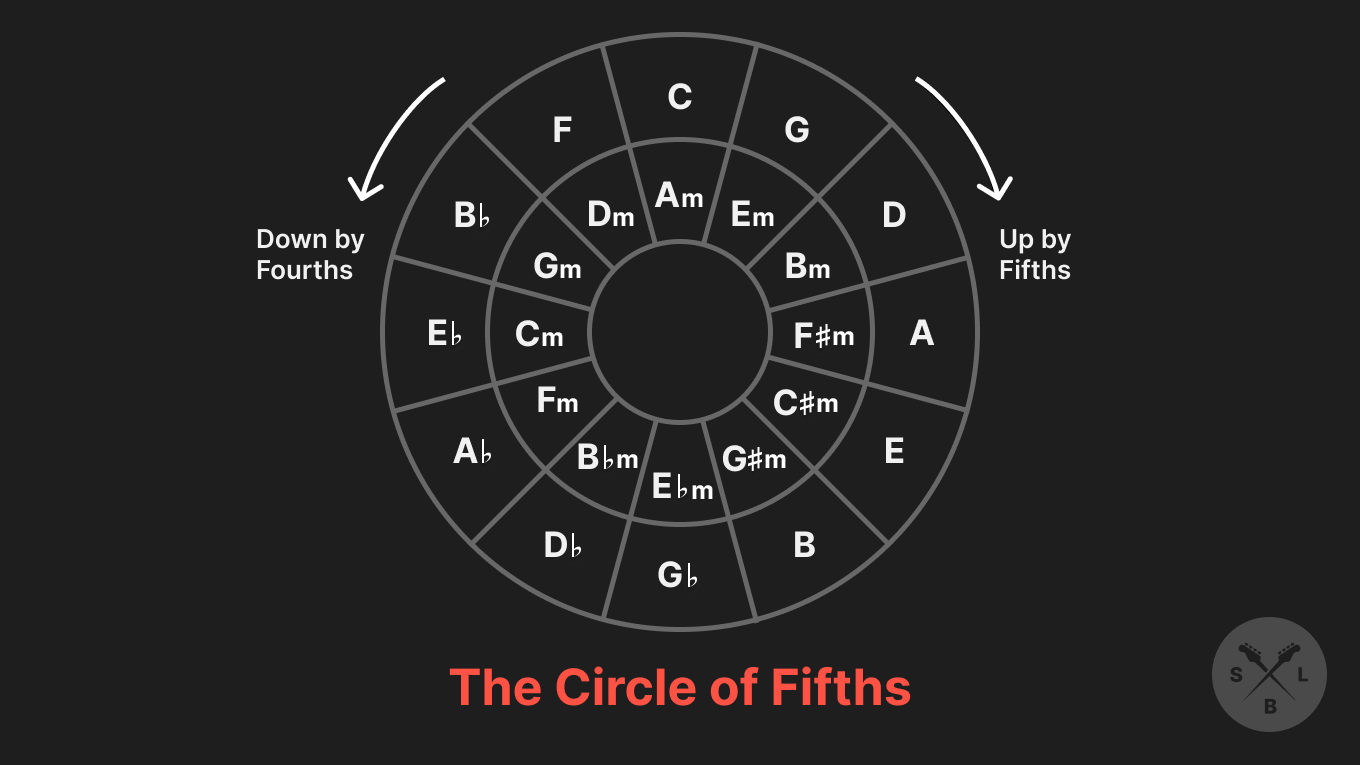
In music theory, the circle of fifths - also called the cycle of fifths - is a way of organizing the 12 musical pitches in a sequence that will help you understand and memorize the 24 major and minor keys used in Western music.
A fifth is the interval from the first to the last of five consecutive notes in a major and minor scale. For example, in the C major scale below, the tonic is C and the fifth interval is G.
In the diagram, the outer circle shows the cycle of fifths in a major scale and the inner circle shows the cycle of fifths in the minor scale. If you look at C in the outer circle, the next clockwise note is G - the fifth as shown in the table above. Every successive note in the outer circle is a fifth above the previous one until you complete the circle and return to C again.
In the A minor scale below, the tonic is A and the fifth is E. If you look at the inner circle of the diagram above, you can see Am is followed by Em, the fifth identified in the table below. If you continue around the circle, every successive note in the outer circle is a fifth above the previous one until you complete the circle and return to Am.
What is the circle of fourths?
So we know that clockwise, the notes go in ascending fifths, but counter-clockwise, the notes move in fourths, a musical interval that you can see in the table below.
For major and minor scales, from A, a perfect fourth above is D. The notes go in fourths all the way around the circle when moving counter-clockwise.
Memorizing the circle of fifths and fourths
It will help your musical journey if you take the time to memorize the sequence of note names in the circle of fifths and fourths. Bassists commonly play fifths and knowing the fifth above any note will be very useful. Try to learn the order in both directions.
You will notice that some notes can be described two ways. For example a G♯ and an A♭ are the same note, just described differently. These are known as enharmonic equivalents and you should be aware of them when learning the order of fifths and fourths.
What’s the point?
Fifths and fourths aren’t special in themselves, but the code they represent will help you unlock other areas of bass theory, in particular key signatures. Gaining fluency around the fretboard is critical to improving your skills and the circle of fifths and fourths is an important stepping stone. Also, check out these bass guitar fretboard charts we prepared to help you learn your way around the neck.
Next steps
If you’d like to learn about harmony, members at Scott’s Bass Lessons have access to a course called Harmonic Layering that will teach you everything you need to know about arpeggios, chord tones and scales for the bass guitar.
To become a member, just go to the course page and click on the ‘free trial’ button. This course alone is worth the price of a year’s membership, but you will also find a HUGE number of other courses as well as gain access to our community where you can ask questions of other members and our pro bass mentor team.