
NEW Program Alert: The Groove Accelerator is OPEN for enrollment! Limited Time Only —Join Now
Music Theory for Bass Guitar: An Introductory Guide to Boost Your Skills
Picture this: you're in the midst of a jam session with your band, the groove is tight, and the energy electrifying. Suddenly, someone tosses around terms like 'intervals' and 'key signatures.’
You nod along, trying to keep up, but actually have no idea what they mean.
Let's get real – music theory can seem daunting, like learning an alien language. But as you begin to understand that language, you can unleash your bass-playing potential, adding depth and richness to your bass lines.
In this post, I’ll break down nine music theory concepts that will turn some of your confusion into clarity. This will give you a basic understanding of this language and help you groove with confidence!
What Is Music Theory?
Music theory is the written way of describing the phenomena of music. It’s been gathered over hundreds of years from people playing and making music.
It covers a wide range of topics:
- Pitches
- Scales
- Rhythms
- Intervals
- Chords
- And patterns
By understanding these fundamental concepts, you can gain a deeper understanding of your potential as a bassist.
It’s important to understand that music theory isn't an absolute, unchanging truth like a scientific law.
It's a dynamic and evolving body of knowledge shaped by musicians and their creative journeys.
Think of it as a tool that was created by musicians who came before you. They played what sounded good, then named and organized it.
This theory means that you don’t have to reinvent the wheel and gives you a head start on your musical journey.
How Does Music Theory Help With Bass Guitar?
The bass guitar is the silent hero in a song. Without it, there’s an undeniable void in the music.
A bassist collaborates with the drums to form the backbone of the rhythm of a song. But it doesn't stop there. Your role goes beyond the rhythm.
A skilled player can add texture and emotion to a song by outlining specific chord tones or accentuating their individual tones—the harmony.
It's an incredibly versatile role that requires you to adapt to the song's specific demands.
And yes, you can trust your instincts and experiment to create remarkable bass lines.
But instead of relying on intuition alone, think of music theory as a roadmap that removes a lot of the guesswork.
It’s your guide to the world of musical possibilities.
On top of helping you create groovy bass lines, it can also:
- Unleash your Creativity
- Develop your ear (recognizing notes, scales, and chord progressions)
- Make learning new songs a breeze
- Help you navigate the bass fretboard with speed and precision
- Help you communicate with other musicians (it's a language after all)
- Boost your confidence as a musician
- Help you land gigs
9 Essential Music Theory Concepts for Bass Guitar
In the next section, I’ll cover the music theory that will have the biggest impact on your playing. You’ll see how music theory can be divided into key areas to practice, and how each part adds to the collective whole.
At the end of this post, you’ll understand what to focus on, why you should learn it, and how it affects you as a bass player.
1. Rhythm and Time Signatures
As a bass player, your job is to provide a solid rhythm and groove. So spending time developing your sense of rhythm is an investment in your bass playing!
Rhythm refers to the patterns of beats and durations in music—it's like the heartbeat of a song.
It decides if notes are played short or long, fast or slow, and creates the groove and feel of the music.
There are two main “feels” for a traditional Western music rhythm:
- The shuffle
- The straight
Different styles of music use different rhythms.
A hallmark of the blues, and what gives it its unique sound, is the shuffle. The notes are typically played in a long-short pattern and create a distinctive groove, like in Before You Accuse Me by Eric Clapton.
While some songs use a straight rhythm—like Flowers by Miley Cyrus.
Rhythm can be tricky. It's like patting your head while rubbing your stomach at the same time. But once you understand the difference, you’ll be able to use a rhythm that sounds best for whatever you’re playing.
Time Signatures
Time signatures are the pulses that keep the music alive. They dictate the rhythm's structure.
The beat is non-negotiable. It’s passing at a certain beat per minute (BPM), regardless of the notes being played.
In order to understand the rhythm of a song, it all comes down to knowing that music is divided into bars (or measures).
The time signature tells you how each of the bars in the song is subdivided. All the bars will follow that rhythm.
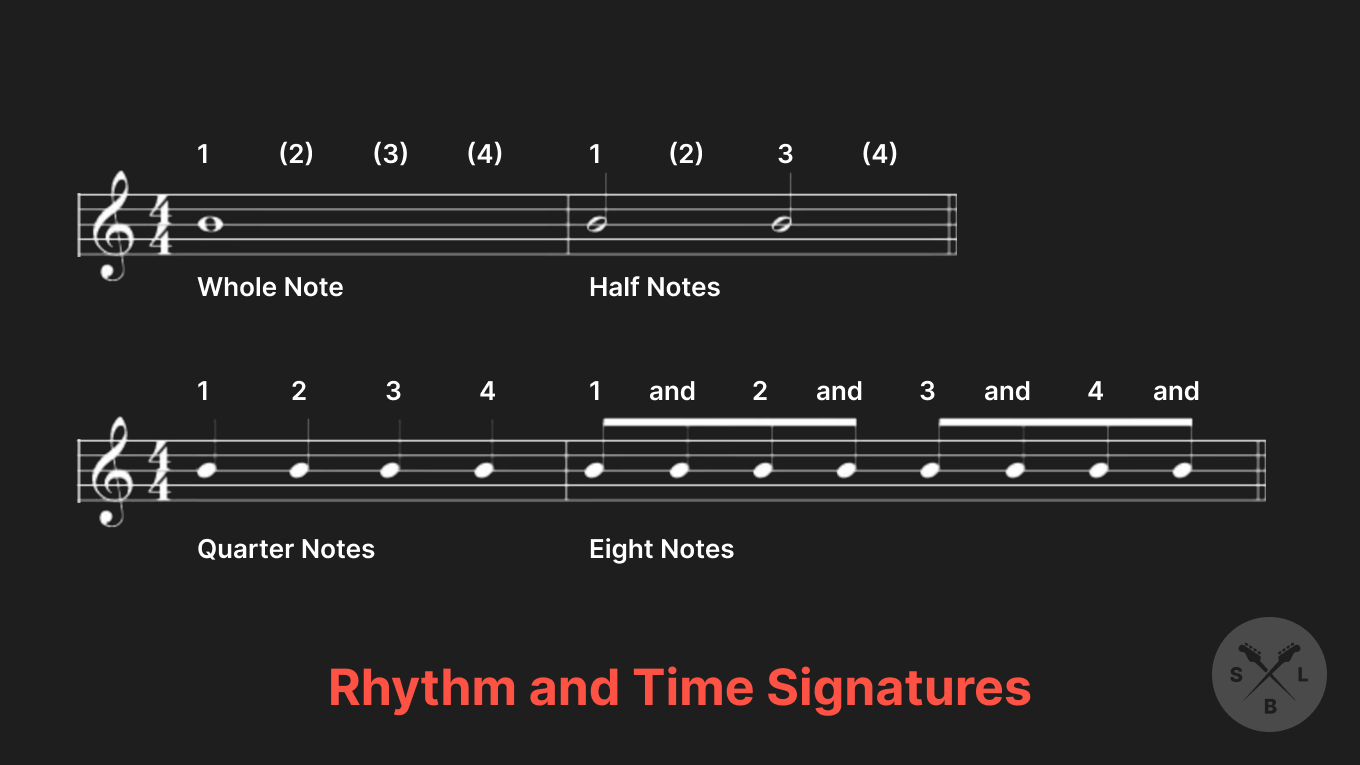
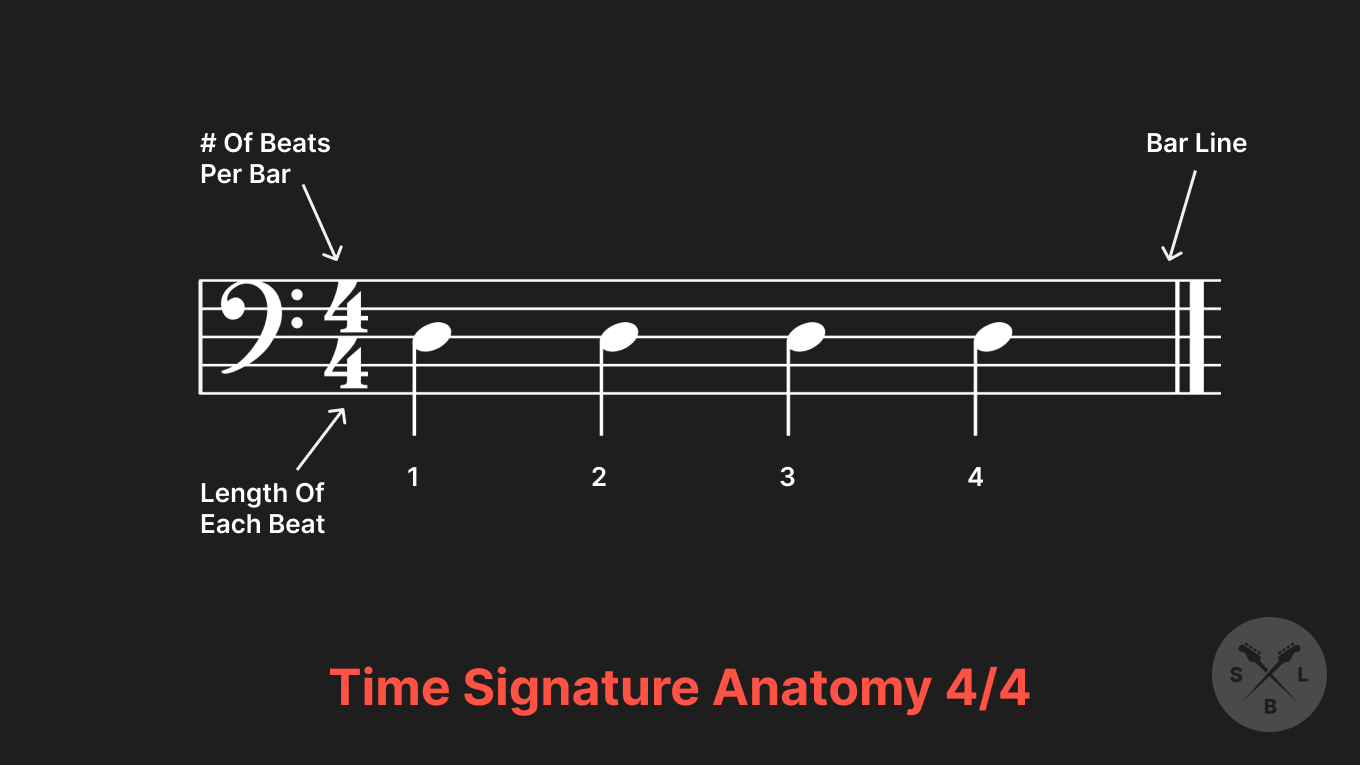
The most common time signature is 4/4.
The top number tells you how many beats there are in a bar.
The bottom number tells you what kind of beat it is. Or how long each beat is.
So 4/4 means that there are four quarter notes.
If you have a 6/8 it means that there are six eight notes in one bar. This rhythm gives the bar a triplet feel.
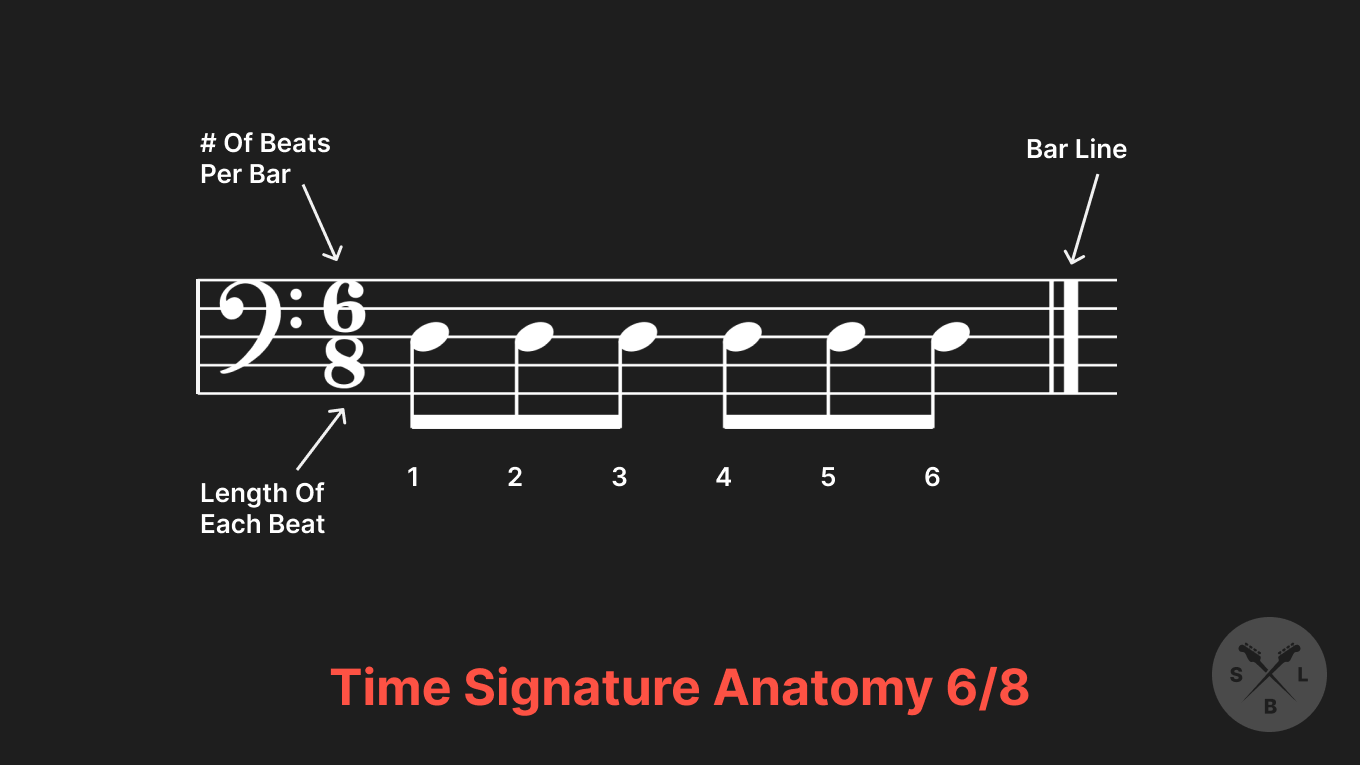
Time signatures help you quickly identify the type of groove that the song has.
Think “In Time”
Rhythm will always have a physical, and intuitive nature about it.
But in order to get better at bass and develop your sense of timing, start thinking about rhythm in terms of “bars”. Thinking about how the bar is being subdivided gives you a mental framework beyond just “the feel”.
And it helps you communicate the rhythm with other musicians.
2. Notes and the Bass Fretboard
As a beginner learning to play the bass guitar, the instrument might seem like an intimidating grid of frets and strings.
But music theory can be your roadmap to learning the notes on the fretboard and playing them faster.
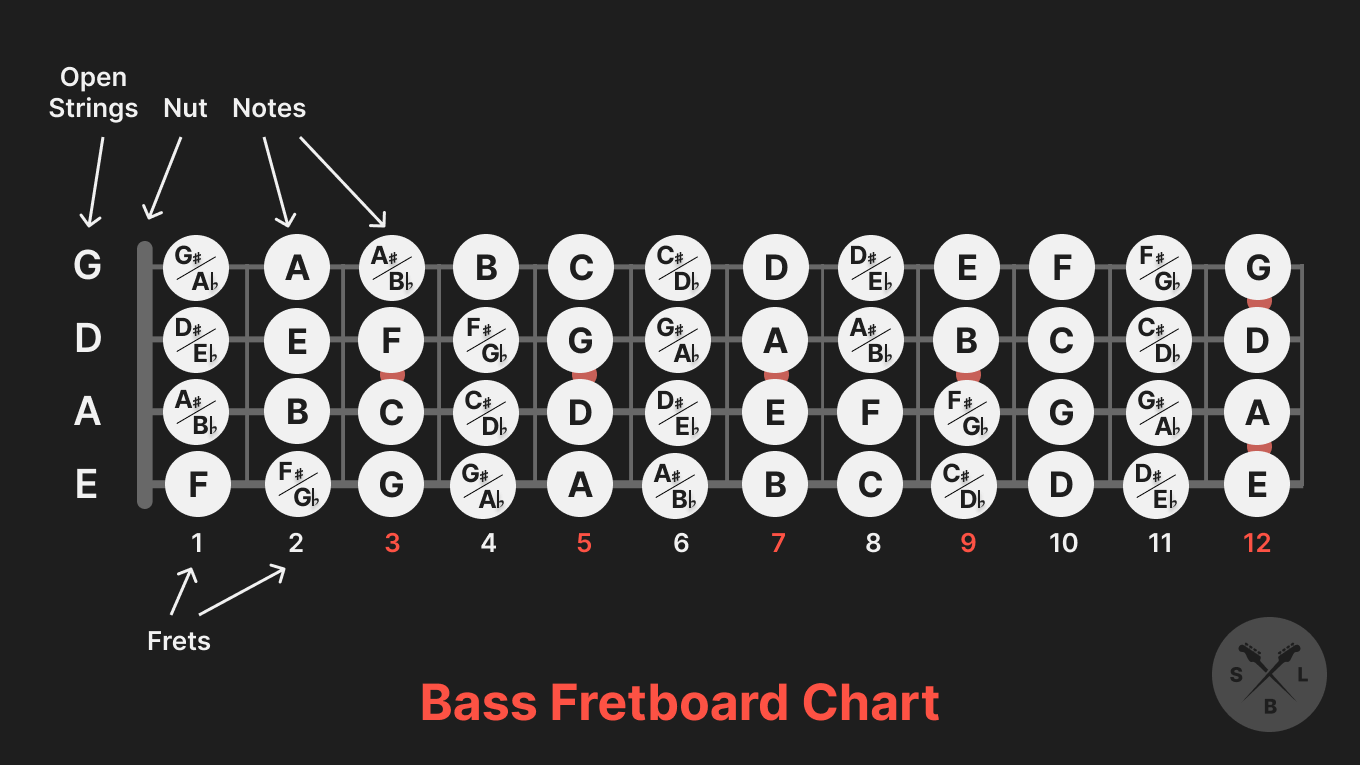
There are only 12 notes—A, A#/Bb, B, C, C#/Db, D, D#/Eb, E, F, F#/Gb, G, and G#/Ab. The notes are just repeated at different pitches along the fretboard.
Meaning that each fret and string is just a different starting point of a connected system.
Think of it like a piano keyboard. Even though there are 88 keys on the piano, it's just the same 12 notes, repeated at different pitches.
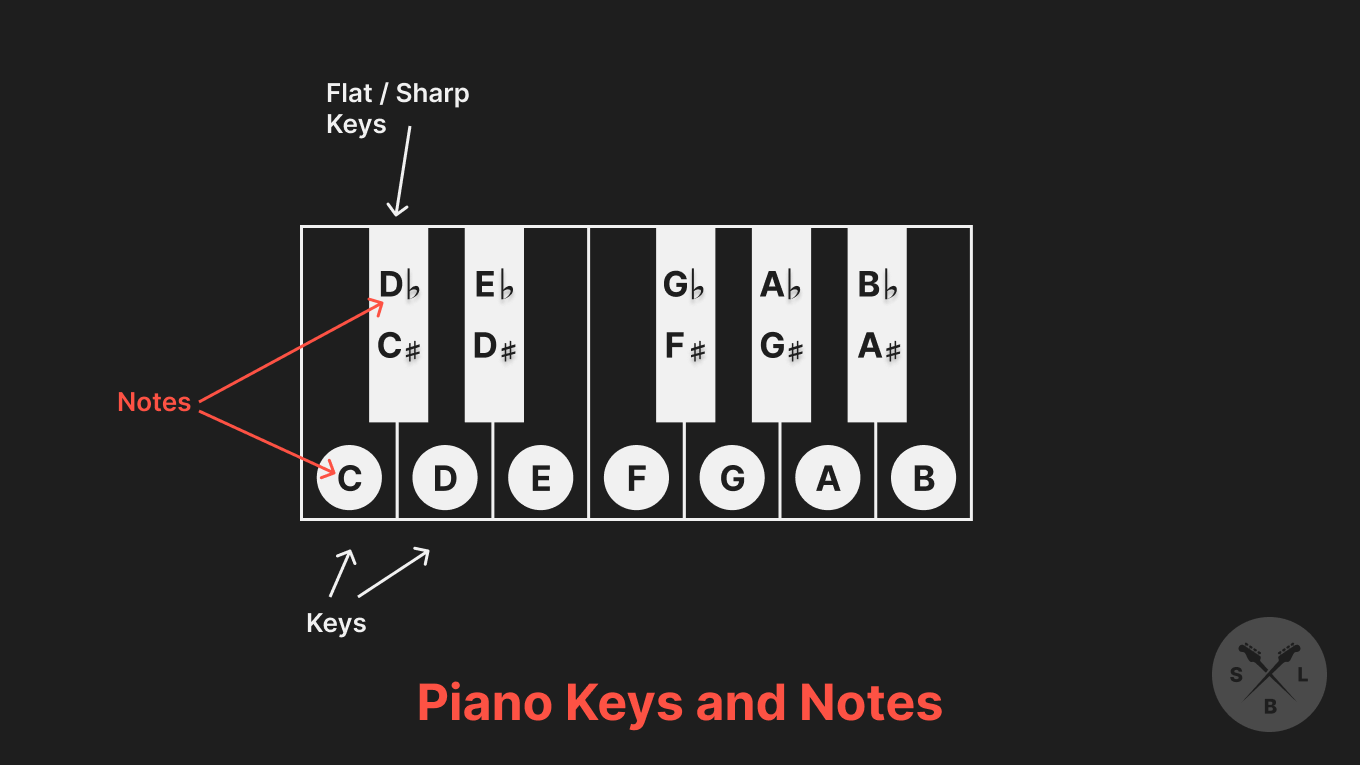
The black keys are half steps or semitones, which is the smallest interval, or distance, between two notes. They are represented by the # symbol if the note is a half-step higher, or the b symbol if the note is a half-step lower. These symbols – # and b – are called accidentals.
For example, take the notes A and B.
Played in order with the half step, you would play A, A# (the accidental), B.
Or if you go the other way, it’s B, Bb (the accidental), A.
Now, go back to your bass guitar…
Starting with your open strings, you have E, A, D, G.
Four of the 12 notes that form the backbone of your music theory are there in your open strings. The notes always follow an “alphabetical” order. Meaning it’s always A, A#/Bb, B, C, C#/Db, D, D#/Eb, E, F, F#/Gb, G, and G#/Ab. Then it repeats.
So if you start by playing the open E string, then each fret and the notes that follow it are F, F#/Gb, G, G#/Ab, A, A#/Bb, B, C, C#/Db, D, and D#/Eb.
Learn where these notes are and memorize them. They're your North Star on this musical map.
3. Understanding Intervals
Simply put, an interval is the distance between two notes. That distance can help you learn the notes on the fretboard a lot faster.
That’s because the interval has a shape on the fretboard.
And you can use that shape to find the note you need and make a riff out of it.
Take the notes A and E. The root note (starting point) is the A. The distance between them is called a 5th. So E = 5th.
That interval has a distinct sound and shape. It becomes the building blocks for the chords you build, and the bass lines you make.
Here are some important intervals and their shapes you should know as a bass player:
The 5th
5ths are everywhere for a bass player—they’re your best friend!
It’s a great choice if you’re not sure what might sound good with what everybody else is doing.
Here’s the shape you can play to find the 5th anywhere on your fretboard. It will always give you the root note and the 5th.
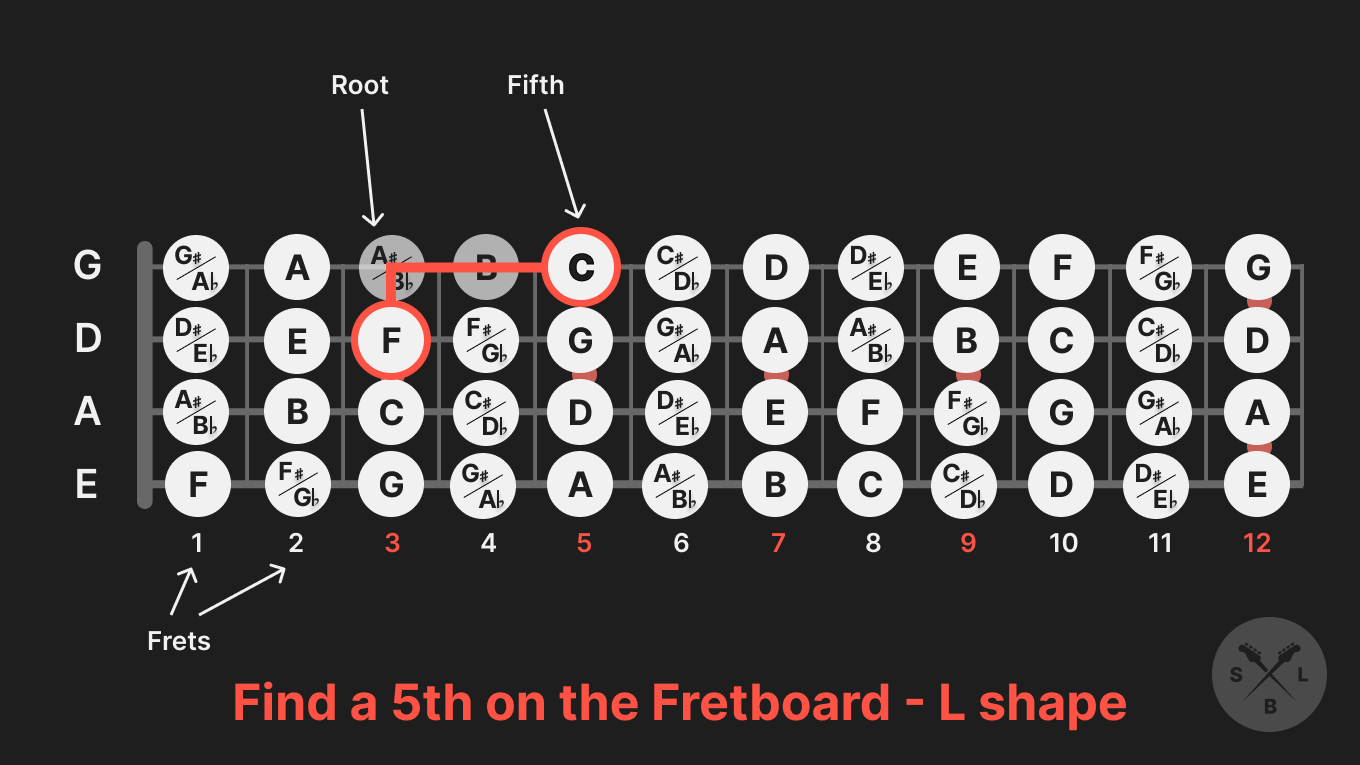
In the example above, F is the root, and C is the 5th. Learn the circle of fifths to see how this simple interval ties together the entire fretboard.
The Octave
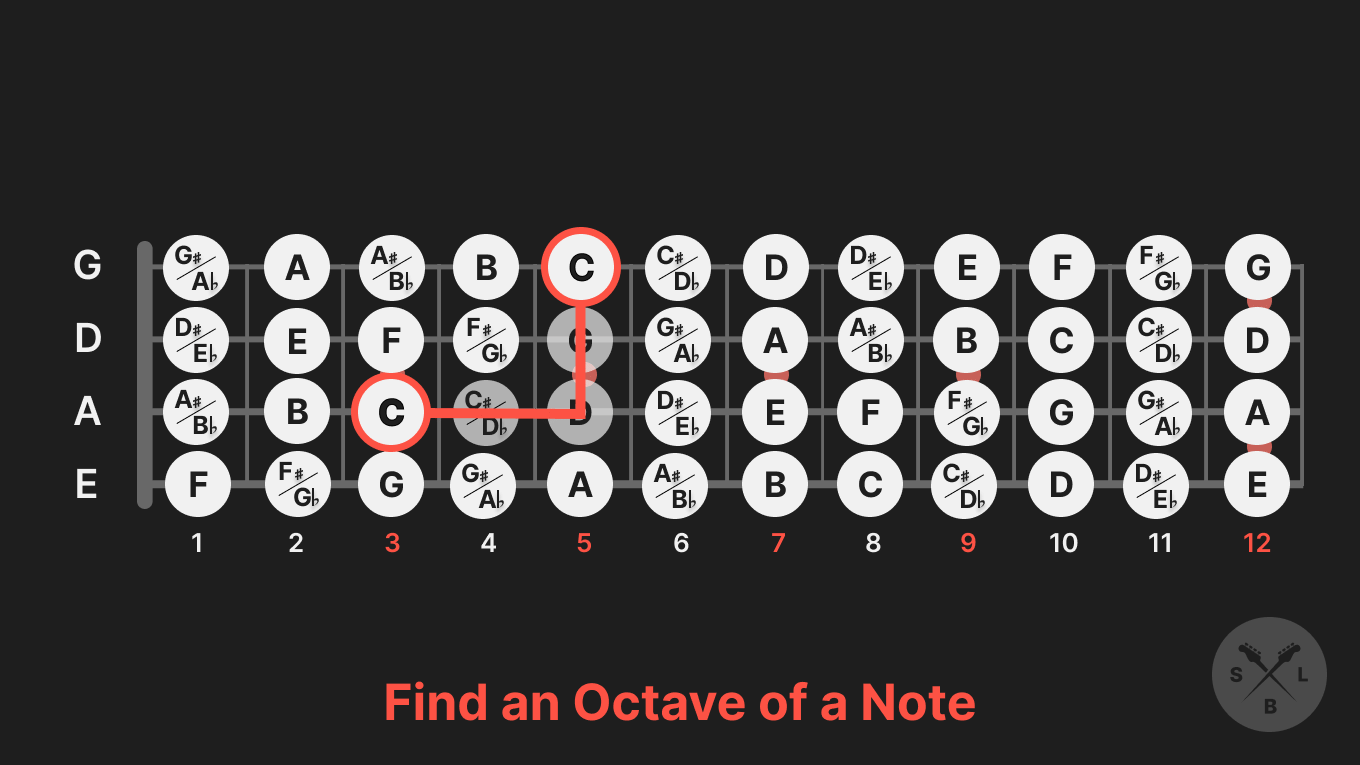
If you play an A, and then another A at a different pitch, that’s called an octave. It’s another really important interval to know and comes in handy when creating riffs.
The Minor 3rd
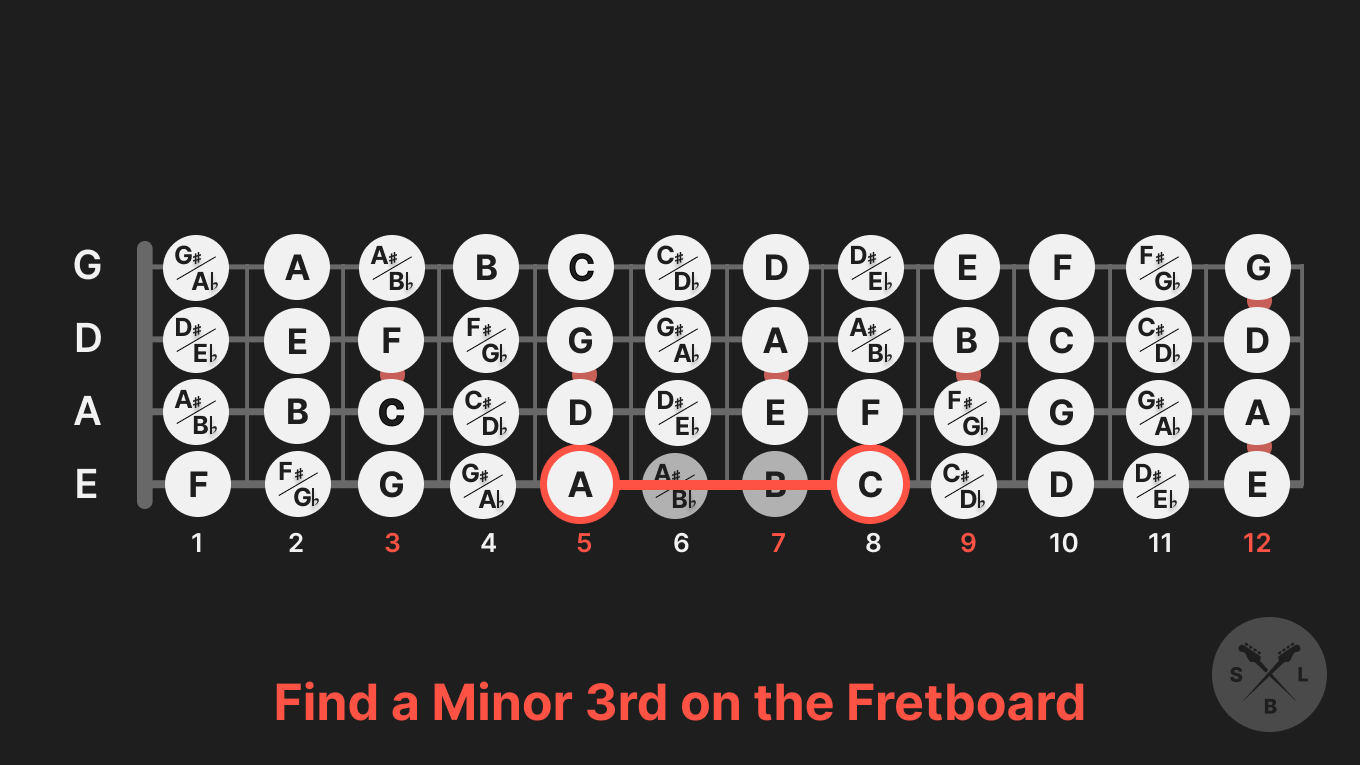
In our example using A, the minor 3rd interval would bring us to C. It’s a handy interval for creating bass lines.
Here’s the shape for always finding a minor 3rd from the root:
4. Scales and Modes
In music theory, scales and modes are both collections of musical pitches, but they have distinct characteristics and purposes. Here's a breakdown of the key differences between scales and modes:
Scales
A scale is a sequence of notes played up and down. It’s constructed based on specific interval patterns (like the minor 3rd and the 5th).
A scale, like the blues scale, infuses a song with soul and emotion. Some common examples of scales are the major scale, the natural minor scale, and the pentatonic scale.
Every scale starts and ends on a root note. This means the root is played twice.
The scale outlines the key that a song is written in.
You can think of a scale as a set of “note guidelines” the band can use. They’re the notes that make the chords and solos sound in key.
Each key for bass guitar (or scale) has a unique sound quality and vibe.
For example, the G major scale (or the key of G) has the notes:
G, A, B, C, D, F#.
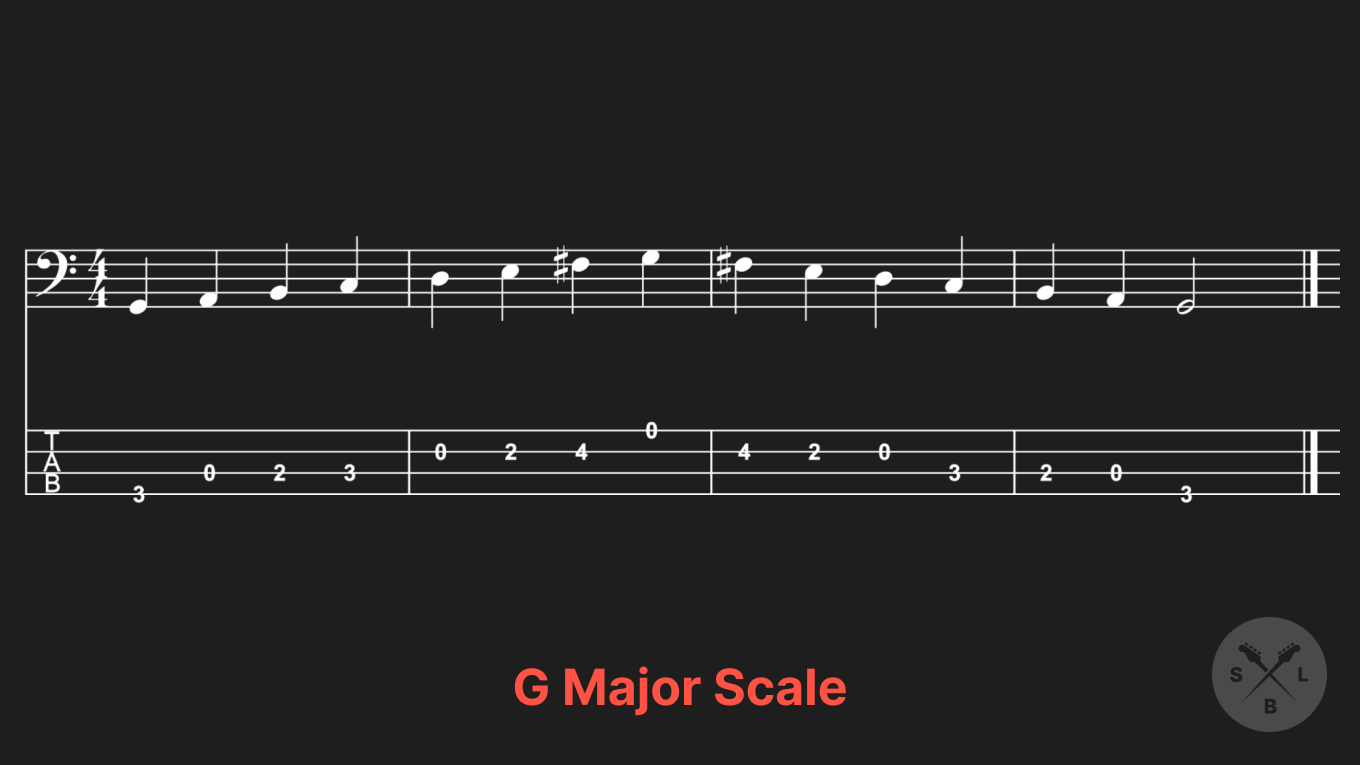
Those notes will make up the chords, melodies, harmonies, and walking bass lines in a song. They give it a theme— a specific sound, vibe, and mood.
Knowing which notes to use, and where they are on the fretboard, empowers you to play a riff that’s in tune and sounds good with the song.
Playing notes from within a scale prevents awkward note combinations that don’t sound good together.
Scale Degrees
There are a lot of different scales you can play. In order to communicate which note to play in any given scale, musicians use scale degrees.
They give each note in the scale a number.
For example, the G major scale degrees are:
- G
- A
- B
- C
- D
- E
- F#
- G
The 1 is always the root note. The 8 is the octave.
Modes
A mode is a subset of a scale. It’s a specific sequence of notes derived from that scale.
So for example, if you take the G major scale, and apply the Phrygian mode to it, the intervals (or distance) between the notes changes.
You’d get the G Phrygian scale:
G, Ab, Bb, C, D, Eb, F.
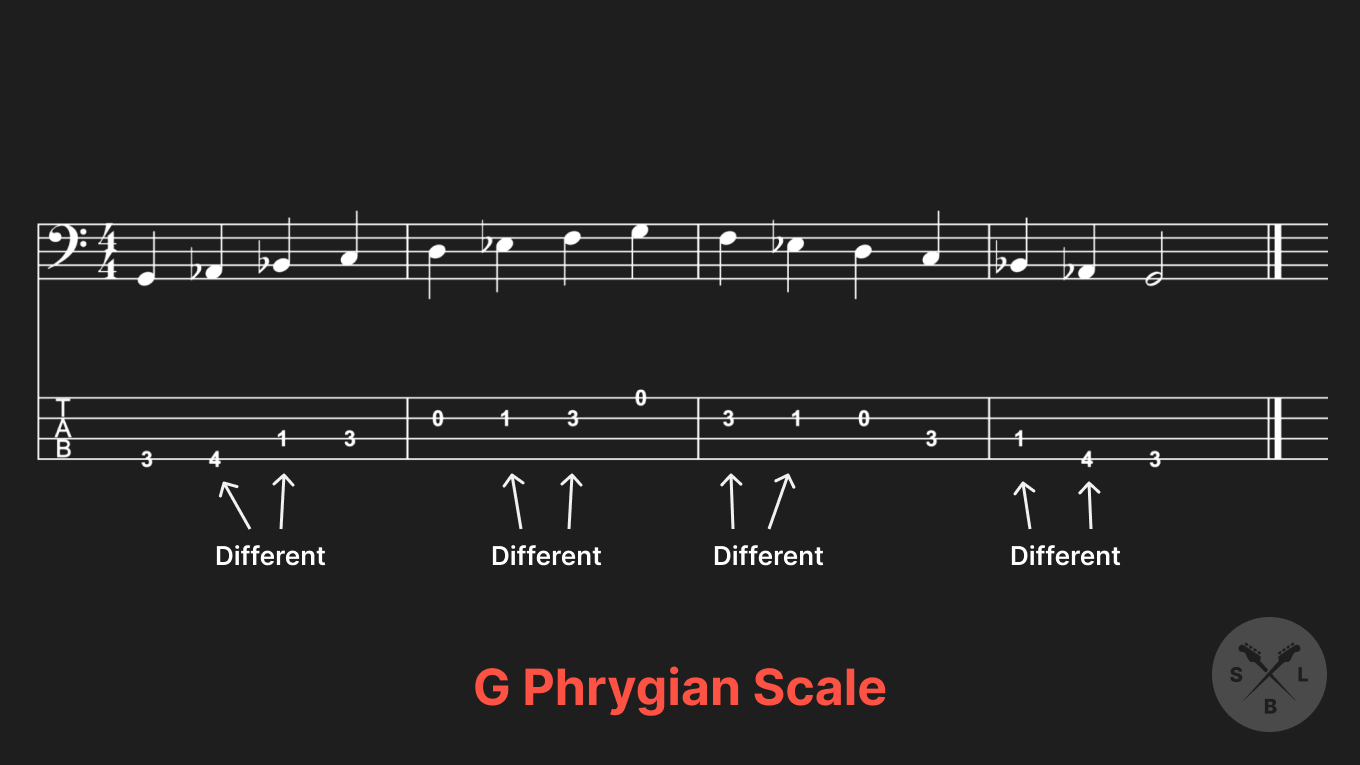
Modes are used to create different tonal flavors or moods within a musical piece. They can bring some extra creativity into your grooves.
There are seven modes that you can experiment with:
- Ionian
- Dorian
- Phrygian
- Lydian
- Mixolydian
- Aeolian
- Locrian
Some types of music tend to use these modes to get their unique sound.
Disco and funk, for example, use the Dorian mode. So if that’s a style you love playing, then learning that mode will be valuable to you as a bassist.
5. Key Signatures
Allow you to know which key the song is in. Or what the notes in the scale are.
The key signature helps you quickly understand the tonal center and what notes will sound good. It also makes reading notation easier.
The circle of 5ths is a great tool for understanding all the different keys you can use and how they are related.
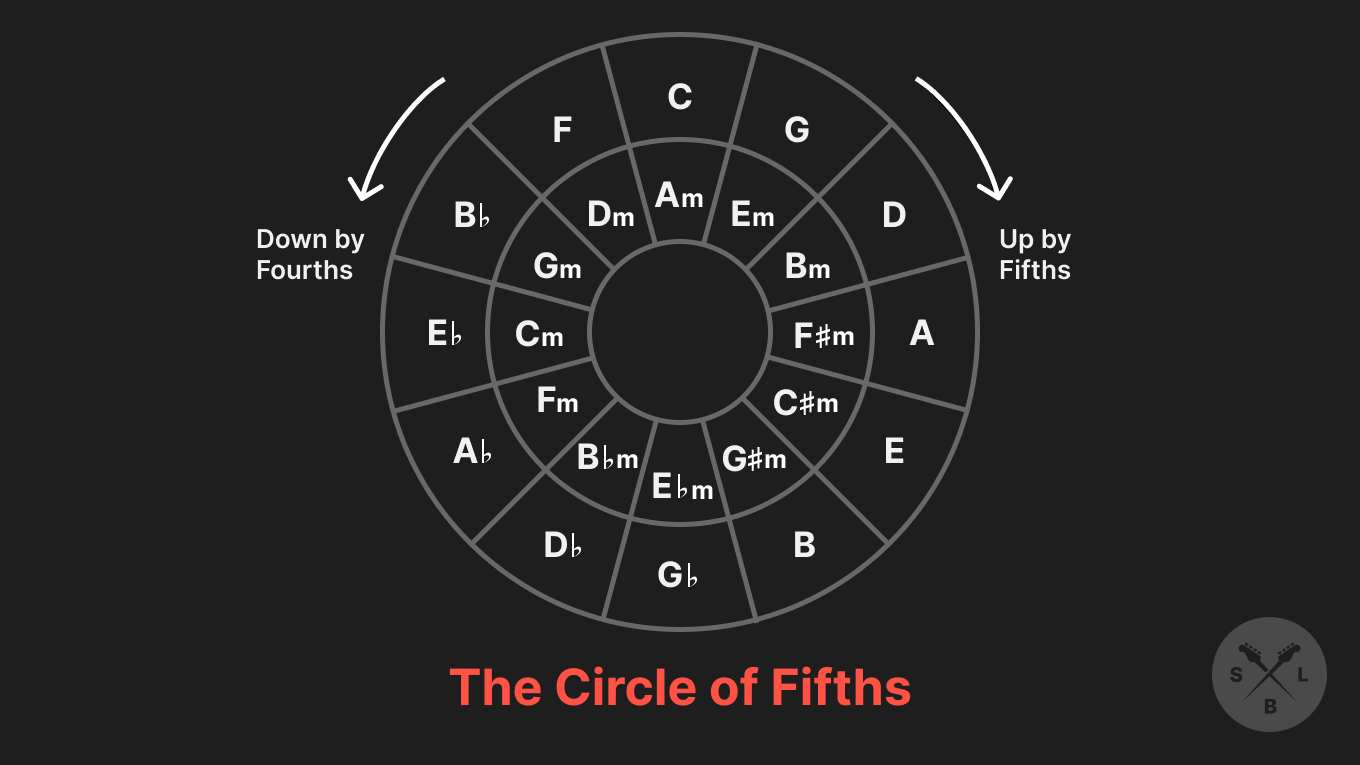
Key signatures are a little confusing at first.
Because instead of telling you what key a song is in directly, they tell you how many accidentals the key has.
Meaning you have to be familiar with the sharps or flats that each key has, in order to know the key.
For example, if the music was written in the key of D major, the key signature would show two sharps (#).
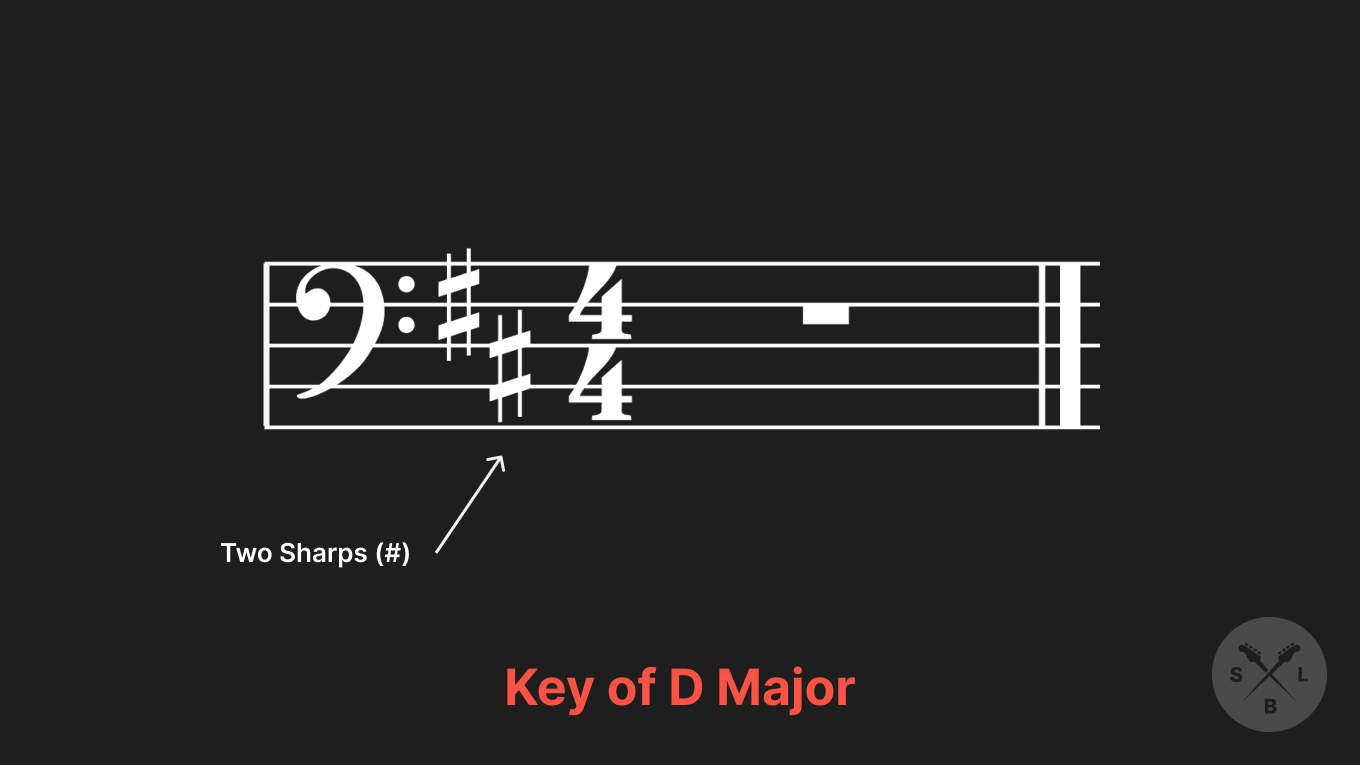
If the key was F major, it would look like this:
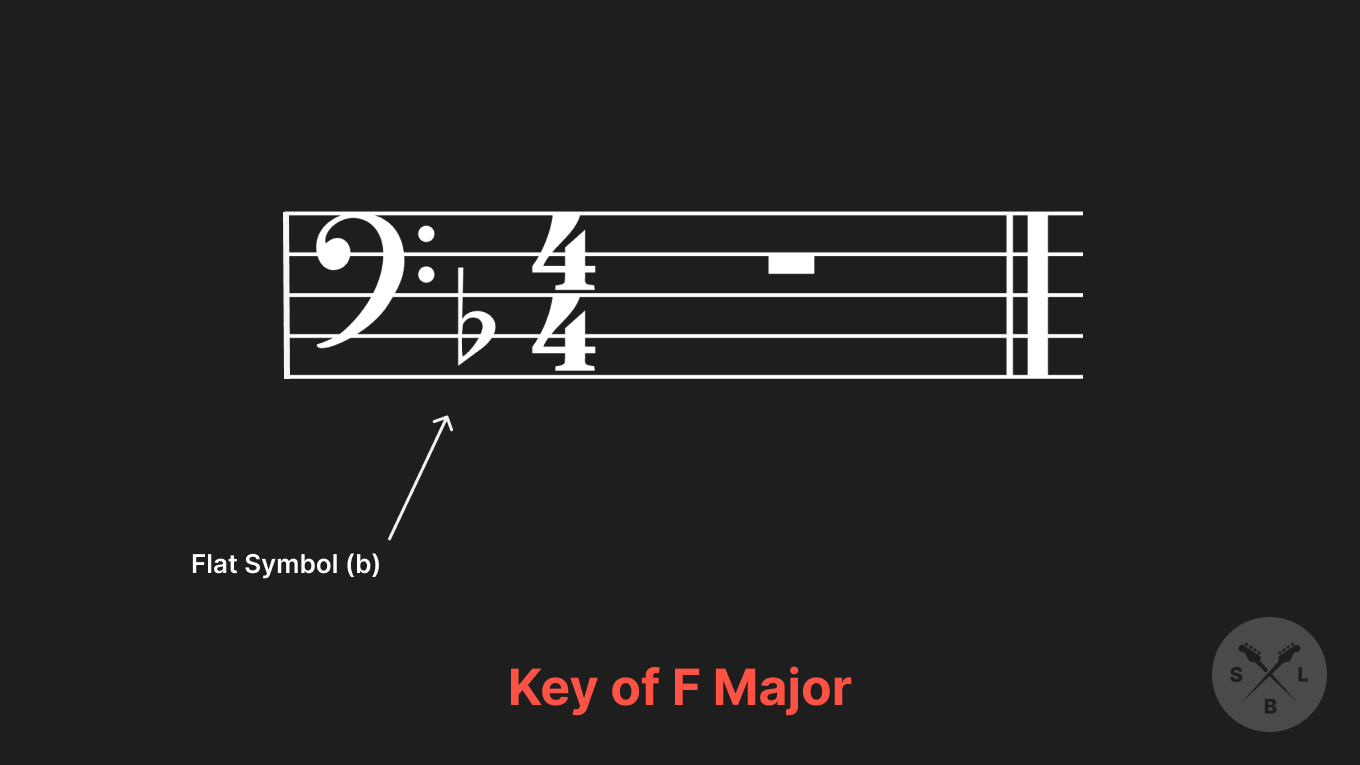
Now, I know this feels unhelpful.
But know that it serves a purpose. It makes reading sheet music easier.
Because instead of having to notate every F and C note as #, you could write it once in the key signature and then know that every F and C going forward is sharp.
It prevents the staff from becoming an overly cluttered jumble of squiggly lines and dots.
Key signatures aren’t something that will dramatically affect your playing initially. But showing up for gigs with that skill definitely boosts your confidence.
It's something that you’ll get more comfortable with as time goes by and the more music theory you know.
6. Chords and Harmony
Everything we’ve discussed up until now has been building up to harmony.
In music, harmony refers to the combination of different notes or chords played together to create a pleasing and unified sound.
Put simply, harmony means things sound good together.
It’s a fundamental aspect of music theory and plays a critical role in shaping the emotional and expressive qualities of a song.
Chords
Are clusters of notes and they're the heart of harmony.
Remember that a key is the harmonic basis for a set of notes. In other words, each key has a set of notes associated with it – notes that make up chords.
The most common chord is the triad.
It’s built by playing three notes at the same time.
For example, play E, G#, and B together:
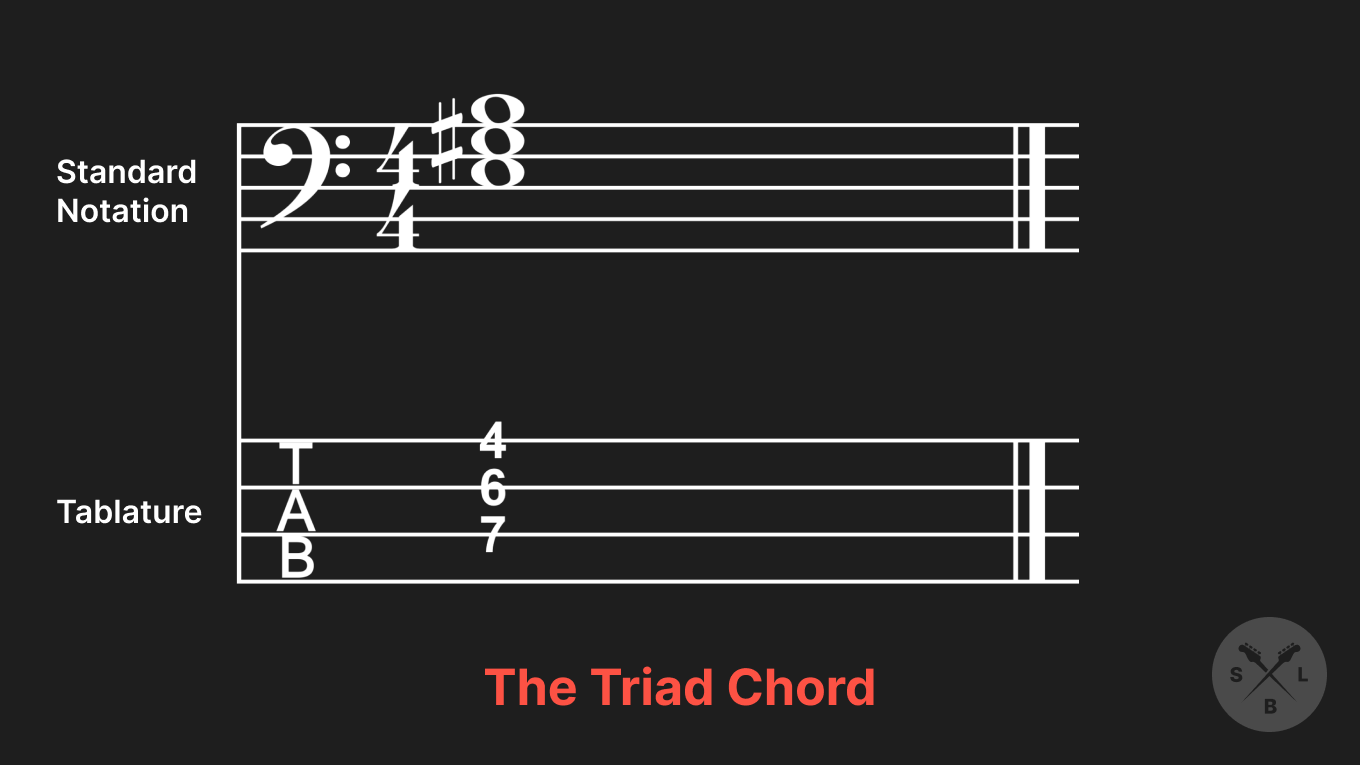
That’s a major chord, and you'll instantly recognize its sunny and cheerful sound.
It’s made by playing the root, the 3rd, and the 5th. Or, the 1, 3, 5, if you’re using scale degrees.
Chords might seem complex, but when you know what key you’re in, then it limits the amount of notes you can choose from. Which makes things easier.
Outline Chords Instead of Playing Them
But it's still important that you understand them.
Because your job is to outline the chords. You anchor the harmony with your powerful bass lines.
Say, for example, your singer and guitarist are playing that G# and B.
If you play a low E (the root), it will give the song power and complete the harmony.
It's why as a bassist, you are the unsung hero.
7. Chord Progressions
Chord progressions are the blueprints of songs, they’re the journey from the beginning to the end to another. It’s like the plot in a gripping novel.
Just like with scale degrees for notes, chords are notated with numbers. Except, instead of numbers, they use Roman numerals.
For example, a famous chord progression is the "I, IV, V, I". It’s a staple in countless songs and tells a story of tension and resolution.
If we use triads to build these chords in the key of C, we would get:
I: C, E, G
IV: F, A, C
V: G, B, D
I: C, E, G
There are many “tried and true” chord progressions. And you can use them as guidelines for making music so you don’t have to create new chord progressions every time you play.
When you learn some of these progressions you’ll begin to see them everywhere. Learning them can help you create better music.
The Best Part
There are many ways to play chord progressions. So even if you “copy” your favorite song's chord progression—you can play it differently using all the music theory you learned so far.
As an example, if you change the rhythm, play it in a different key, or add in some different notes, it becomes something new.
8. Ear Training
Training your ear means you have the ability to recognize and replicate musical sounds.
It’s the hallmark of good musicianship, and it’s sort of like a superpower. When you can identify notes and intervals by ear, you can play any song just by listening, no sheet music is required.
Think of ear training as tuning your radio to the perfect station. You can pick up even the subtlest nuances in music. And the good news is that it’s something you can develop over time. It’s not just something you’re born with.
How to Develop Your Ear
Try this simple ear-training bass exercise to begin with. It’s called pitch matching.
Play your favorite song, and listen to the bass line. Then, using your bass, HUNT, and find the correct pitch of the groove.
You’ll know when you play the right note, and you’ll definitely know when it’s not the right note. It helps if you “sing” the note you’re trying to match out loud.
It’s a simple exercise, but it's challenging at first. Don’t give up, just try to match the pitch with what you hear.
9. Transposition and Modulation
Transposition means changing the pitch or key of a song.
You move the notes (the melodies and chords) up or down by an interval. And you end up with a new version of the same music that sounds higher or lower in pitch.
You might transpose a song for a couple of reasons.
1. Vocal Range. If a song's original key is too high or too low for a singer's range, transposing it to a more suitable key allows the singer to comfortably hit the notes.
2. Instrumentation. Different instruments have different preferred keys. For example, brass instruments often prefer flat keys like Bb or Eb, while string instruments might favor sharp keys like D or A. Transposing can make the song more playable for a particular instrument or ensemble.
3. Personal Preference. Changing the key can also alter the mood and feel of a song. Some keys sound brighter and happier, while others sound darker and more sad. Transposing can help you achieve the right emotional effect.
Modulation
Modulation is the transition from one key to another within a song.
It’s not something you want to do on the fly. But it’s an option you can use when you’re creating chord progressions.
It gives the song more:
1. Emotional Expression. Modulating evokes different emotions. Starting a song in a minor key and modulating to a major key can create a sense of uplift and optimism.
2. Variety. Staying in the same key throughout a song can become repetitive. Modulating to a different key adds variety and keeps the listener's interest.
3. Musical Climaxes. Modulating can be used to build tension and anticipation, making the eventual return to the original key more impactful.
Are You Ready to Create Better Grooves?
If you think about the music theory concepts I covered as ingredients to cooking up fantastic bass lines, then you have all the ingredients you need.
Getting to your next level of bass playing means applying these concepts to create better grooves. So it’s time to put the theory into practice.
But just like with cooking – it helps to follow a recipe. And if you want to follow proven formulas that session musicians use, SBL Academy offers tons of learning pathways to make you a better bass player.
Try SBL Academy free for 14 days!