
How to Play a Walking Bass Line: A 5-Step Formula
If you’re a beginner bass player and you want one of the BEST ways to take your skills to the next level, then you gotta learn how to play walking bass lines!
Not only is it one of the most practical bass techniques, but it’ll help you understand how chords are constructed. This means you’ll be playing with some pizazz and not just running arpeggios up and down the neck!
It’s also incredible for building up your understanding of the bass fretboard – your internal map. This means you’ll be able to see where you’re going and navigate around the neck confidently.
Today I’ll break down what a walking bass line is and then give you a practical 5-step method for mastering them.
Let’s dive in!
Originally published in 2020, this article was updated and republished on September 13th, 2023.
What Is a Walking Bass Line?
The walking bass line is a quarter-note rhythm, common in jazz and swing, driving the groove and harmonic flow of the song. It's called "walking" because it moves melodically, outlining the chord tones instead of staying on a single note.
While the other musicians are playing and doing their thing, you're playing a series of notes on your bass that match up with the chord, add some flavor, and smoothly “walk” into the next chord.
So, if the rest of the band is playing a C chord, you might start by playing the root note C on your bass. Then, you might switch between other notes in the C chord, keeping a steady rhythm, until they switch to a G chord.
Here's the Fun Part:
You don't have to play the exact same notes as the chords.
As you’ll see, you can add in some “extra notes” in between to make it sound cool – like you're playing a little melody that fits together with the chords.
Whether you’re into jazz or not, walking bass lines are unbeatable as a tool to improve your playing.
It might sound a bit tricky at first, but with a little guidance and some practice, you'll get the hang of it in no time!
How to Play a Walking Bass Line
The theory of playing a walking bass line is fairly straightforward.
The main thing to remember is that you’re just outlining the chords that are being played.
You do this by playing a chord tone (a note in the chord), usually every quarter note.
The only limit to your creativity is how much practice you’re willing to put in. The more you do, the more mastery over the fretboard you’ll have.
5-Step Formula for Creating Walking Bass Lines
Each step in the formula adds a little bit more music theory to your bass line. But it also opens up more creative possibilities, which is where the fun lies!
When you feel like you’ve mastered a step, move on to the next.
Before you start, you’ll need some music to play along with. You can grab the Jazz backing track from my video above and follow along, or choose your own.
Step 1: Root Notes
Starting with root notes is the best place to start, especially if you’re a beginner or intermediate player.
It keeps things simple and will help you understand where your root notes are on the fretboard.
Play the root on each quarter note for as long as that chord is being played.
For example:
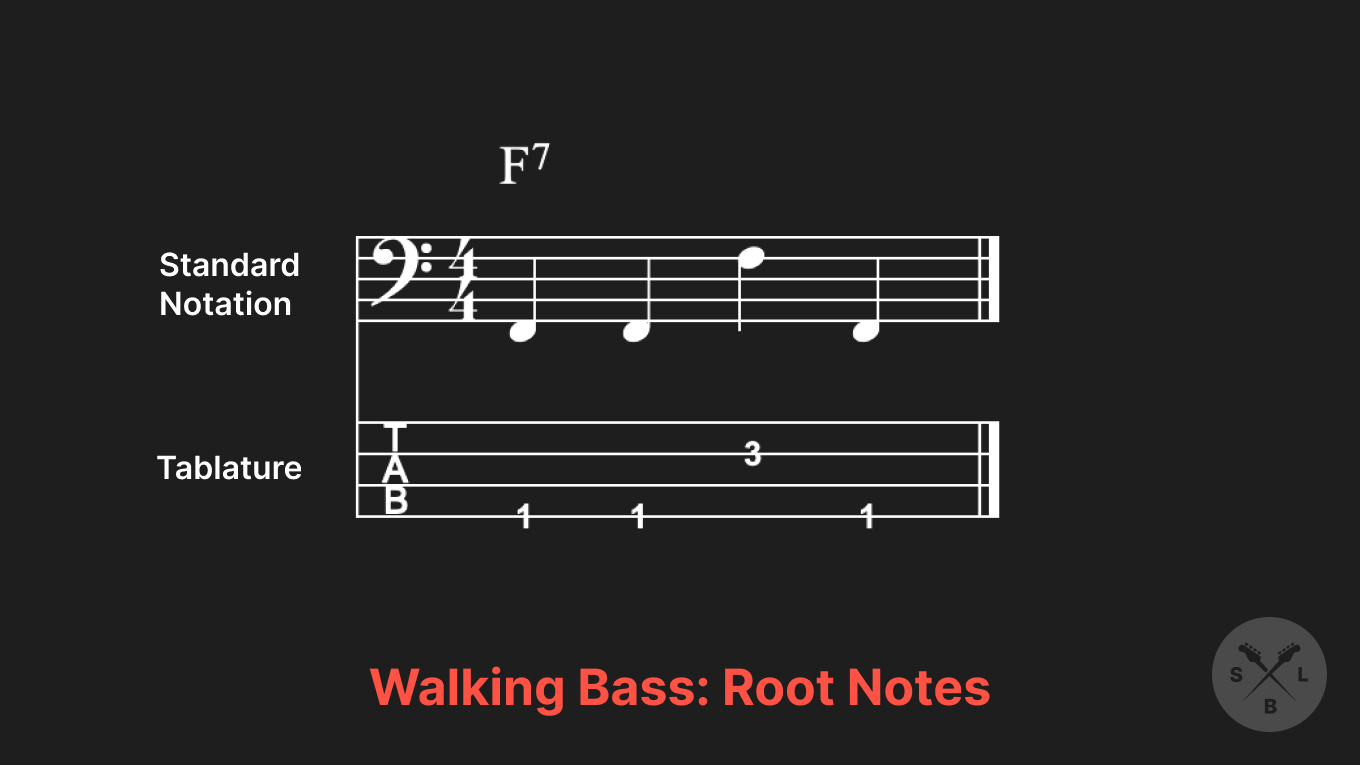
When an F7 chord (F, A, C, Eb) is playing, hit an F note (the root) on each beat.
Once you can do this comfortably throughout the song, move on to the next step.
Step 2: Roots and 5ths
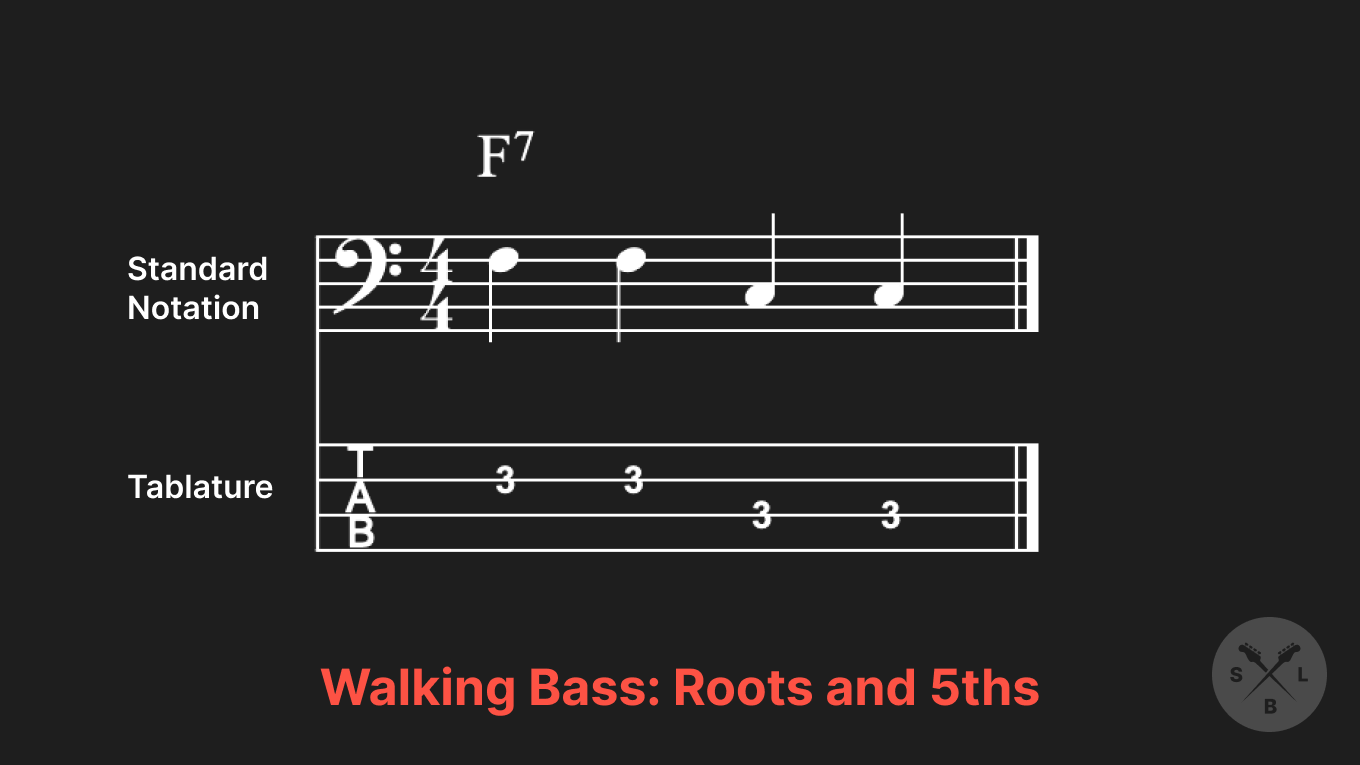
The next step is to start adding the 5th of the chords. So in our F7 chord example, you would play the notes F and C.
How to Find a 5th
Knowing where the root notes are is half the battle. Once you have the root, let’s say F for example:
- Go up 1 string
- And up 2 frets
Making a sideways “L” shape.

Alternatively, you can:
- Go down a string
- And stay on the same fret

That’s the pattern for finding your 5ths.
And just like before, as you play along with the backing track, play either the root or the 5th on each beat.
Step 3: Add the 3rds
Once you’ve got your roots and your 5ths down, it's time to add in the 3rds.
In our F7 chord (F, A, C, Eb), that’s the A note.
How to Find a 3rd
First, find your root note. Then:
- Go down one string
- And down 3 frets
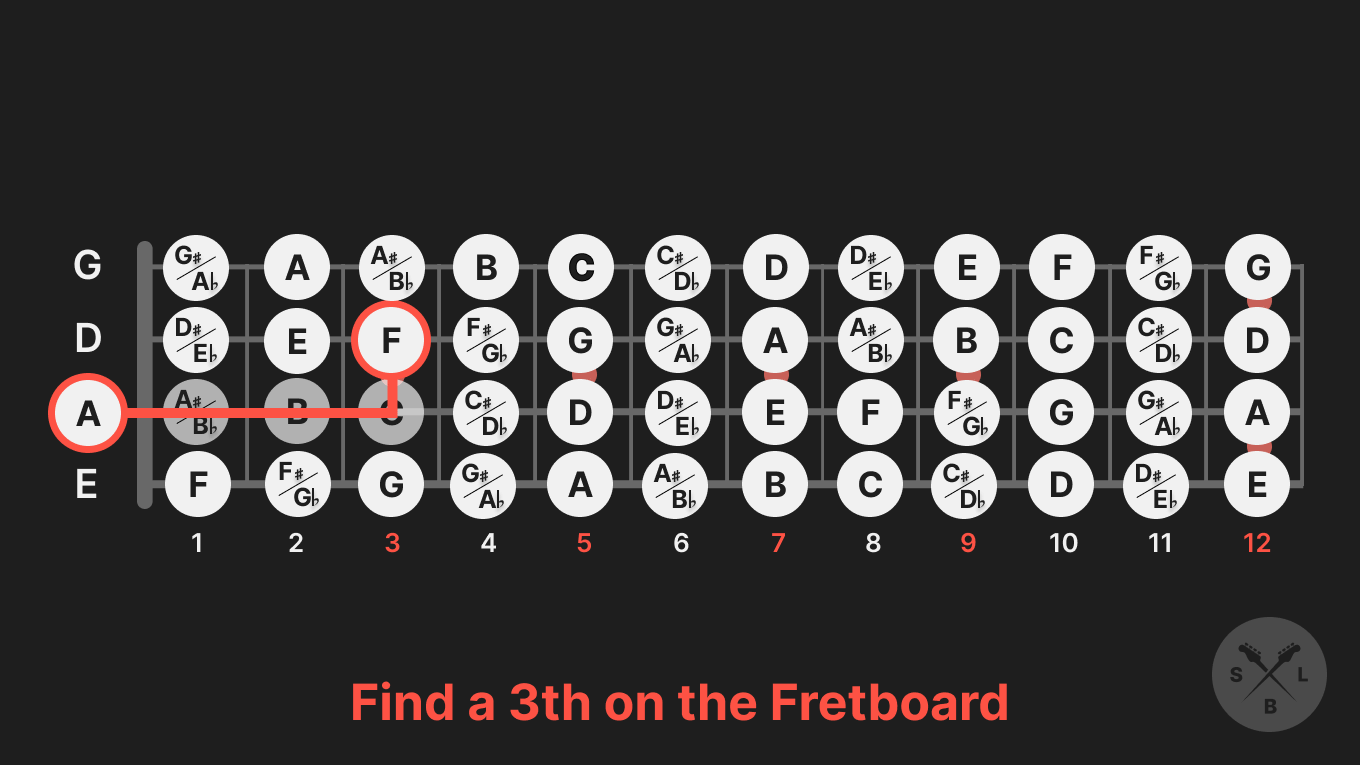
In this example, you would get the 3rd by playing the open A string (fret 0).
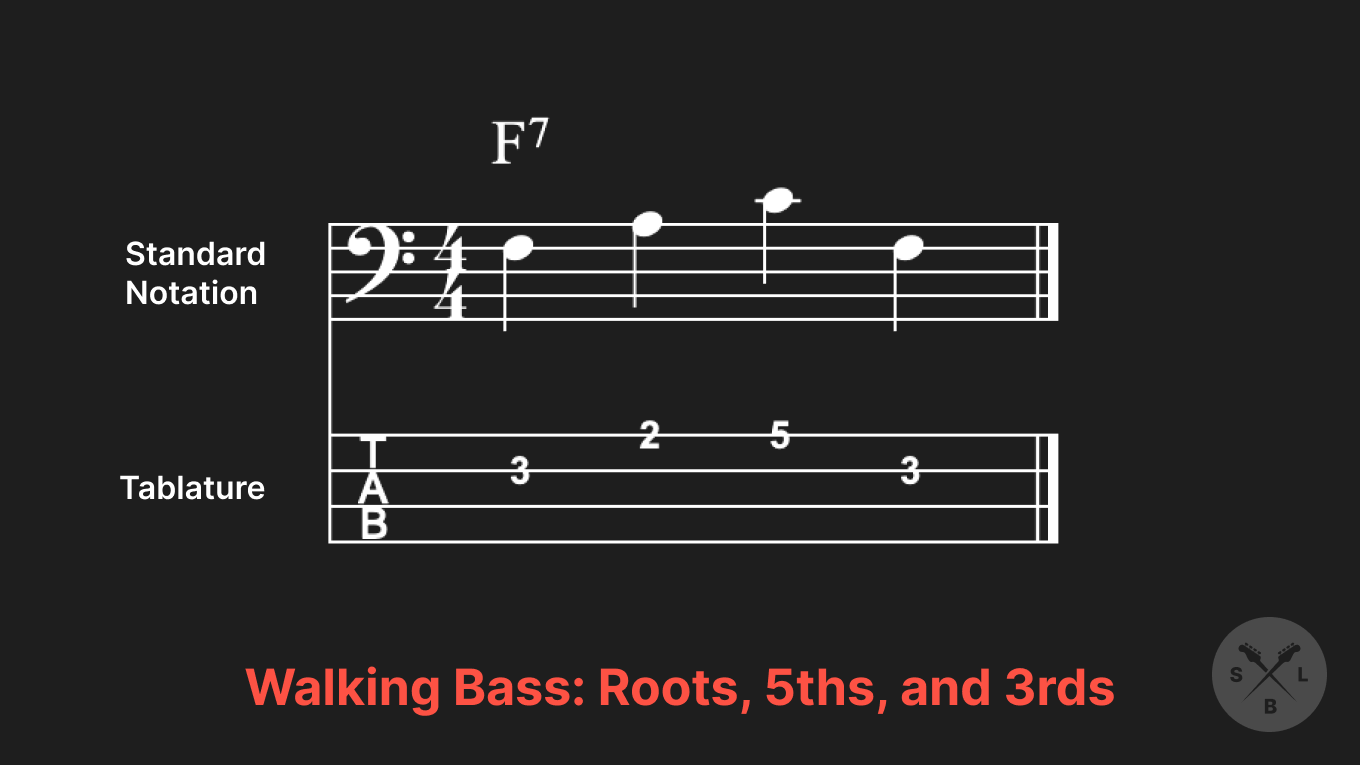
You can play the notes in any order you choose because you're just outlining the chords. Though starting the bar on the root note is a recommended best practice when you're starting out on walking bass.
Get Creative
If you can play a walking bass line with roots, 5ths, and 3rds, give yourself a pat on the back!
There are a ton of possibilities for you to play with using only these three chord tones. So you can start getting creative with your walking bass line.
Step 4: Add the 7ths
Adding the 7ths is a little more advanced and requires you to be more comfortable with the fretboard. But it also allows you to create even groovier bass lines! So keep practicing until you get here.
The idea is still the same as before.
On each quarter note, you’re playing the individual notes that make up the chord.
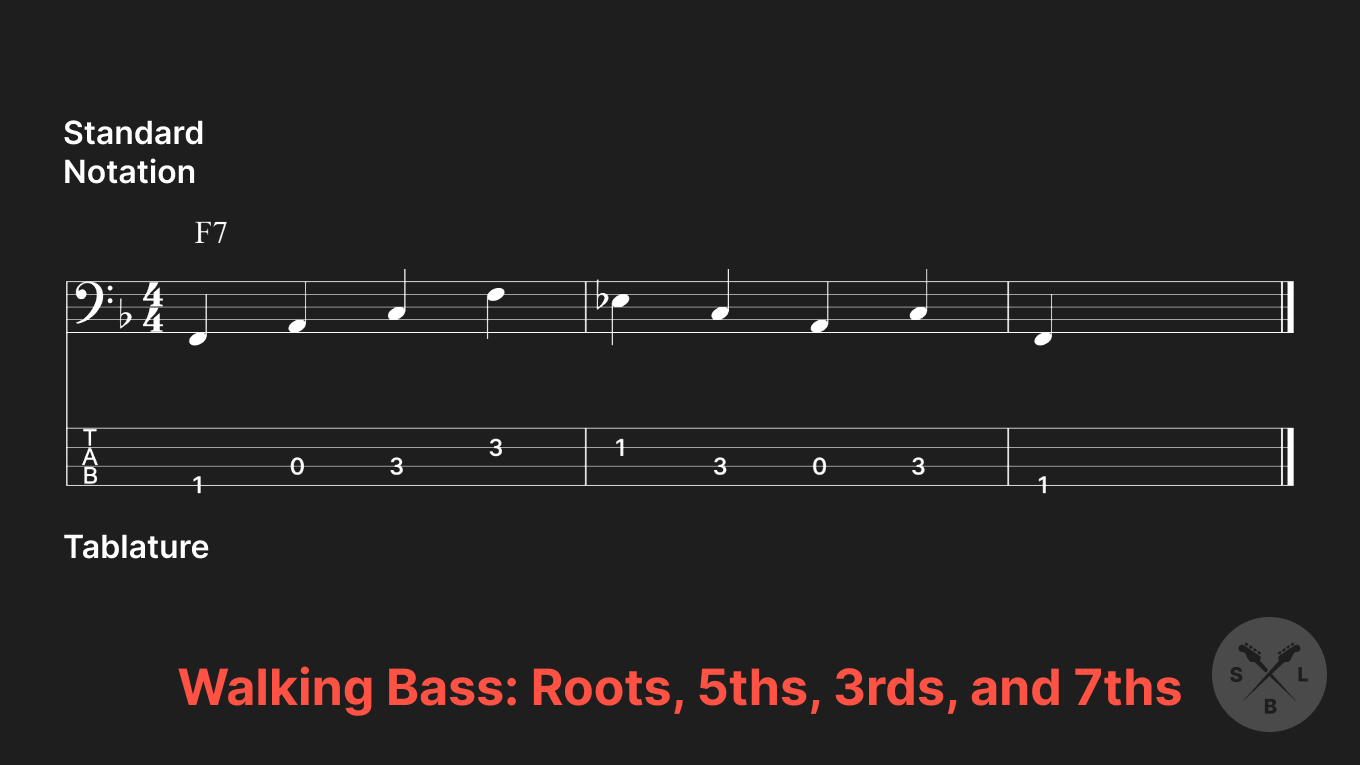
So for our F7 chord, you could play F, A, C, Eb.
You can do that with all of the chords. As mentioned before, playing the root first is a good best practice because it helps to establish the sound of the chord. In time, as you gain more experience you can experiment with starting on other chord tones, though you'll want to avoid the 7th as a general rule.
Step 5: Chromatic Approach Notes
A chromatic approach note is when you approach a note chromatically (in semitone steps).
These notes are also called passing tones because you “pass through” them to land on the note you want.
So when you're playing a walking bass line and you're about to hit a chord tone, you can throw in a chromatic approach note right before it.
This note is usually one step away from the chord tone, but it also could be several steps away, as long as you “walk” it down to the chord tone.
Let's use our F7 chord leading into a Bb7 (Bb, D, F, Ab) chord as an example.
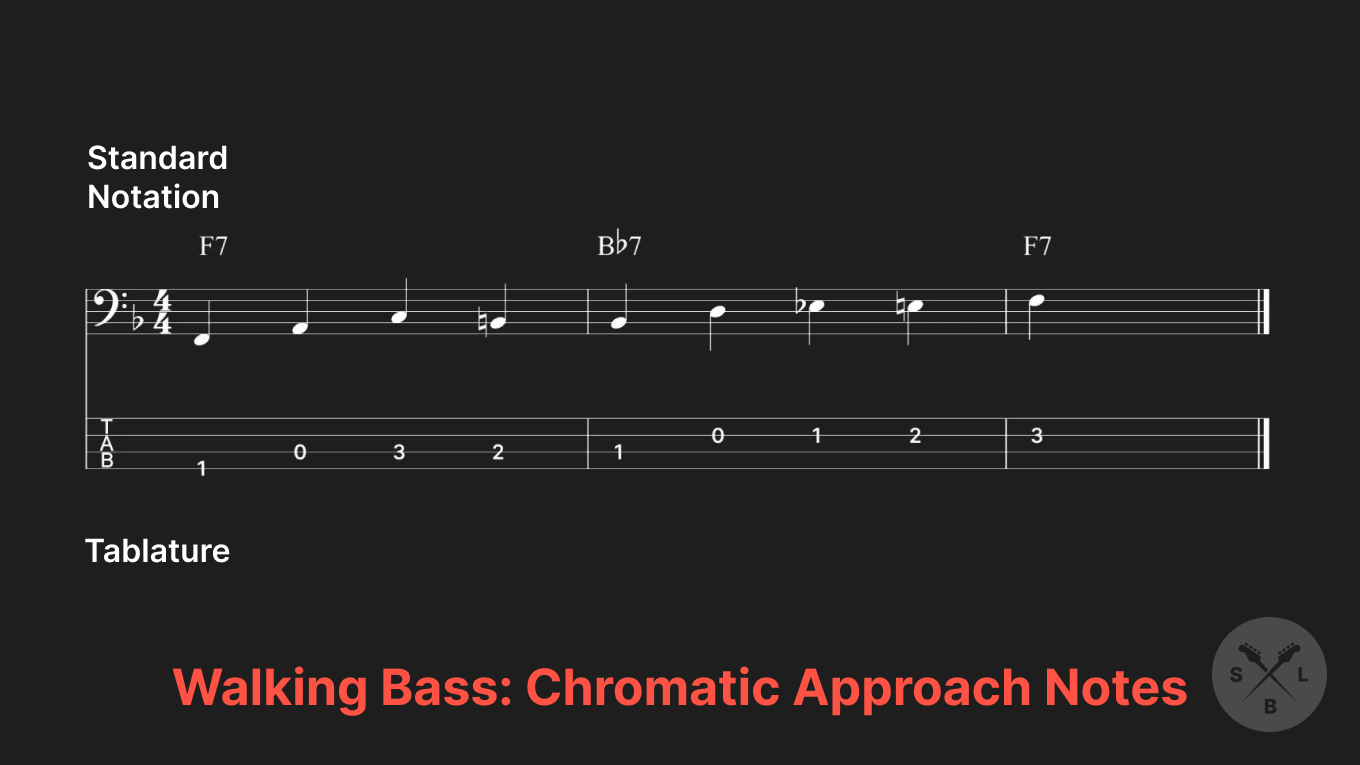
You can use approach notes to “walk” to any of the chord tones (root, 3rd, 5th, or 7th).
They add a sense of movement and color to the bass line.
Too Much of a Good Thing
Chromatic approach notes are like salt in cooking – a little bit can really enhance the flavor.
They make your bass line more colorful and give it a jazzy twist. But don't overdo it. Use them sparingly to keep your bass line sounding smooth and tasteful!
Your Path to Bass Mastery
You have everything you need to start playing a walking bass line!
It’s up to you to practice and build your technique so you can confidently navigate your fretboard.
Embrace the challenge. Embrace those fumbling first attempts, and the times when you're not sure which note to play next.
Because it's those moments that lead to growth. This journey isn't about perfection, it's about progress and the joy of making music that resonates.
Remember that every great bassist was once where you are now.
And if you want to learn from some of the greatest bass players in the world to attain bass mastery, then try the SBL Academy free for 14 days!