
Understanding the Parts of Your Bass Guitar
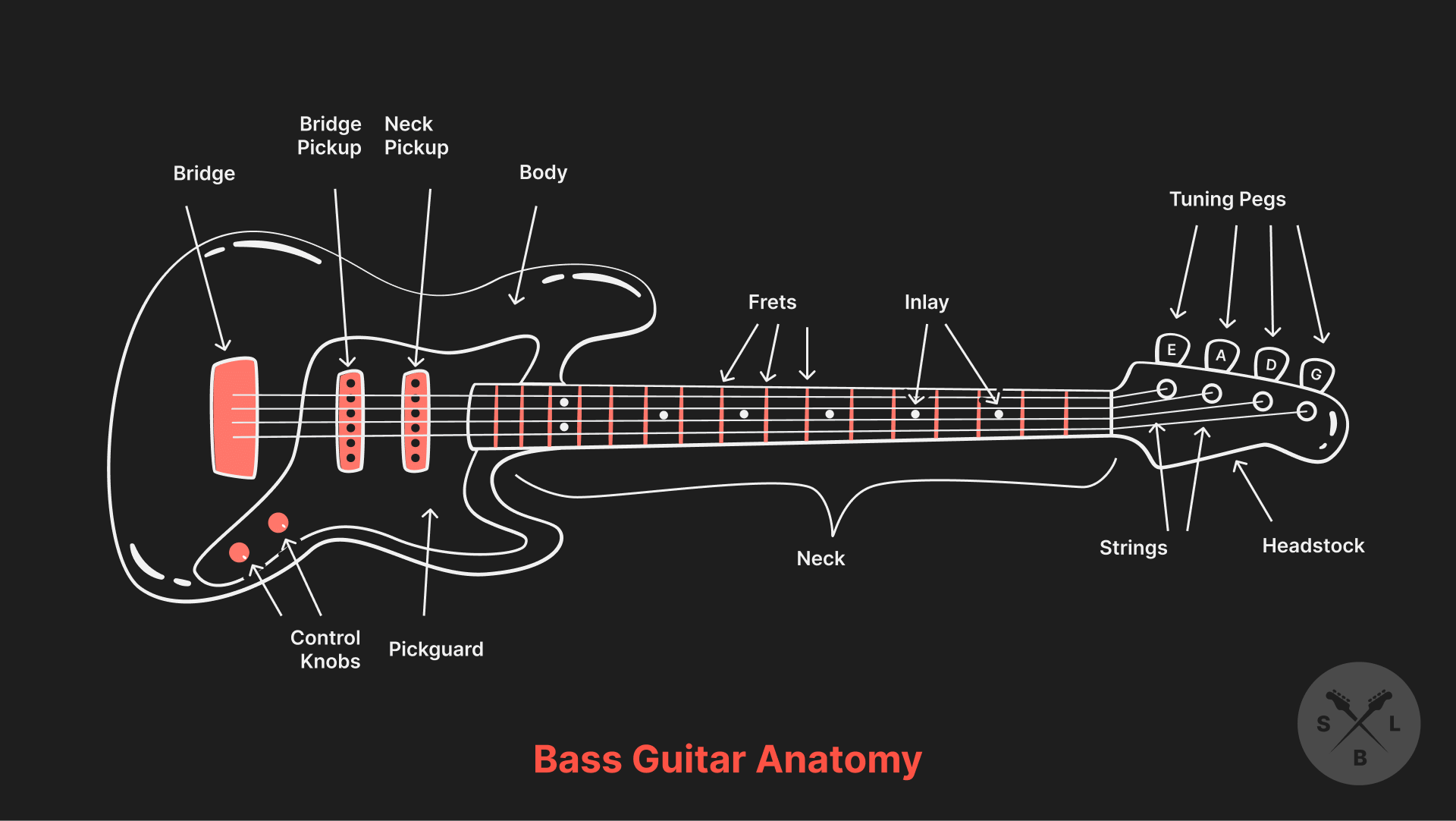
Have you ever been in a situation where your bass guitar was acting up, but you couldn't quite pinpoint the problem?
Maybe you’ve tried searching for an answer online, but the technical jargon left you feeling even more confused.
As a bassist, learning about the parts of a bass guitar is just as important as learning how to play the bass.
To help you better understand bass guitar anatomy from the headstock to the body, I’m going to run you through every inch of my favorite four-stringed instrument!
The Headstock
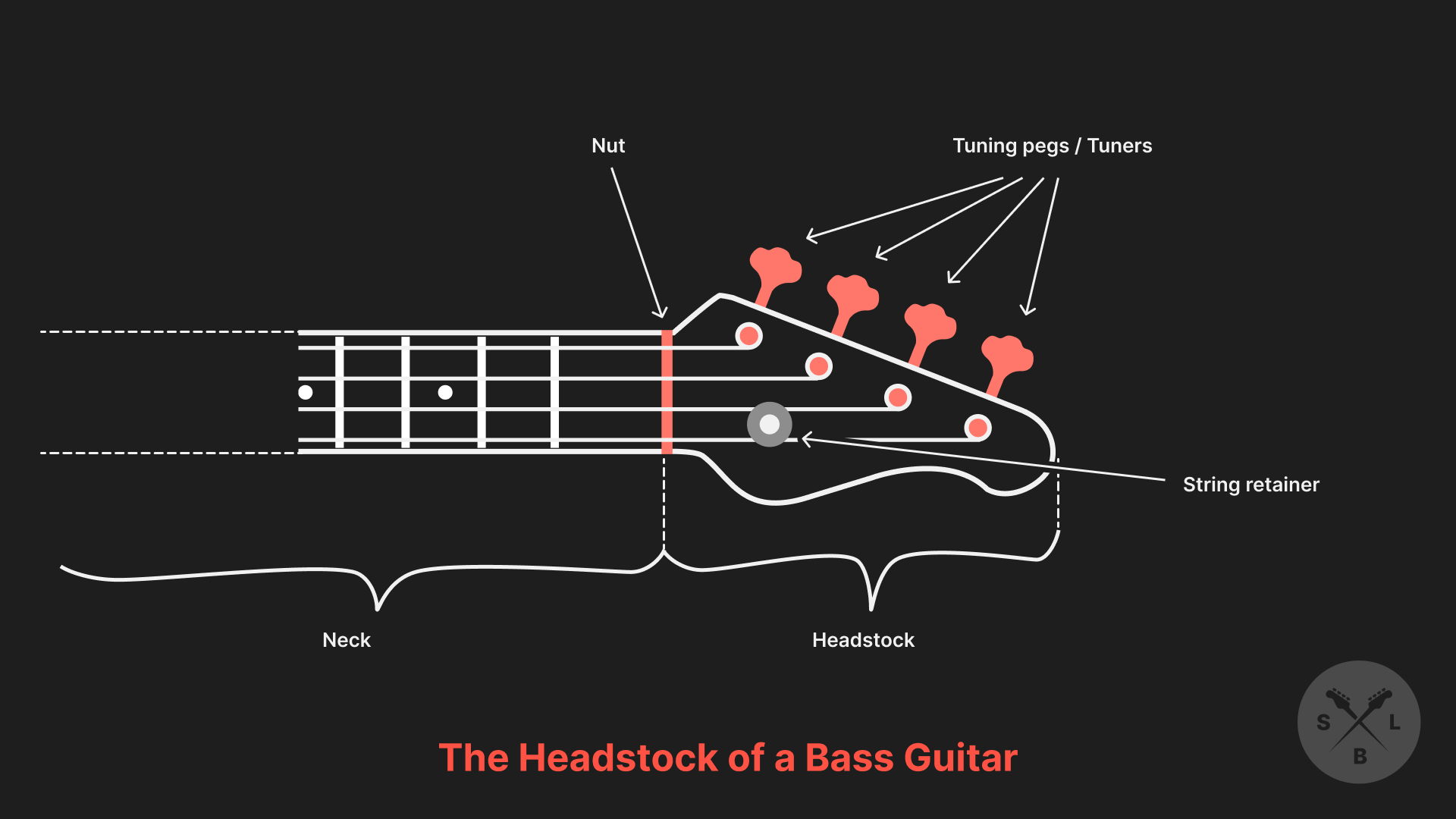
Let’s start at the top with the headstock.
The headstock (sometimes simply called the head) is the anchor point for the strings.
It’s home to the three parts of the bass that help control string tension—the tuners, the nut, and the string tree (also called a string retainer.)
These three parts work together to control the tension of the strings, ensuring that your bass stays in tune.
1. Tuning Pegs (Tuners)
Tuning pegs come in different shapes and sizes, but all do the same thing—keep your strings in tune.
Each string winds around a tuning post. The tuning post connects to the tuning peg. When you turn the peg, you adjust the string tension, resulting in a change in pitch.
Turning the tuning peg loosens or tightens the string, which either lowers or raises the pitch respectively.
2. Nut
The nut is a small piece of material (usually made of graphite, plastic, or bone) that sits where the headstock meets the neck.
It guides the strings to the tuning pegs and keeps them in place.
The nut is also the starting point of the vibrating length of each string, which affects the bass’s intonation. Nuts are crucial for saving you from string rattling or buzzing.
3. String Tree (String Retainer)
The string tree (or string retainer) is a small device attached to the headstock. It applies downward pressure on the strings—particularly the thinner strings—to maintain proper string tension and keep them from slipping out of the nut slots.
Not all basses have a string tree. If the headstock is angled downward enough from the nut, the bass will likely be fine without it. But a string tree is a must for bass guitars with the headstock on the same level as the neck.
The Neck
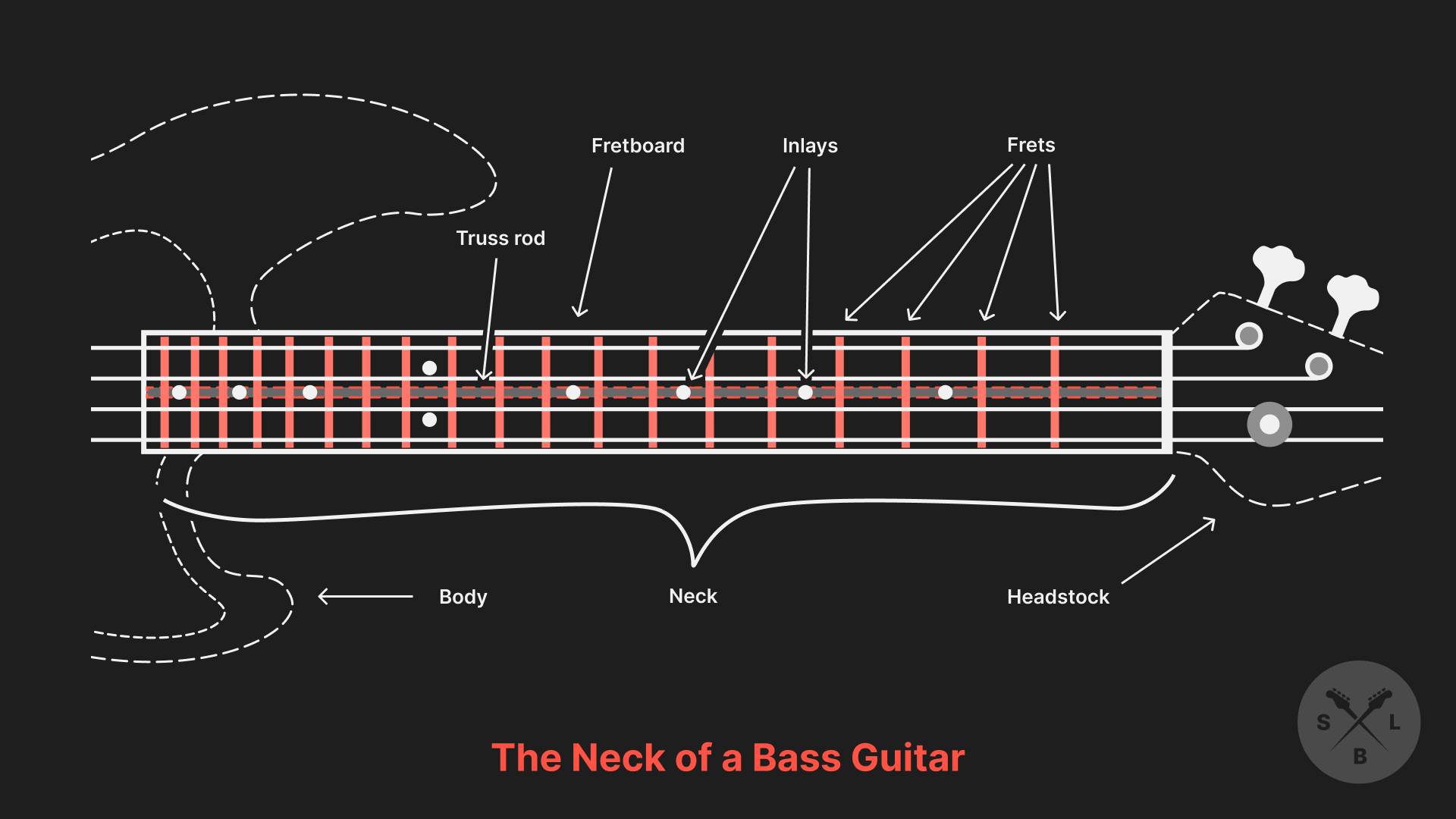
Moving down from the headstock is the neck. This long, slender part of the bass runs from the headstock down to the body.
The neck is the foundation for the fretboard. It’s home to the frets, inlays, and truss rod for the bass.
The neck’s profile, which refers to its shape and thickness, varies depending on the manufacturer and model, but this is mostly a matter of preference. That being said, bass necks are all usually similarly constructed from hardwoods like maple, mahogany, or rosewood.
1. Fretboard
The fretboard is where the action happens!
Sometimes called the fingerboard, it’s the thin piece of wood glued to the front of the neck, directly under the nut.
Fretboards are usually made from a durable wood like rosewood, ebony, or maple. This gives them a smooth surface and influences the bass’s tonal sound (although this isn’t considered a universal fact by all bassists and luthiers!)
2. Frets
Frets are the thin metal strips embedded perpendicularly along the fretboard. These divide the fretboard into semitone intervals.
Each fret represents a different note. Pressing a string down behind a fret shortens the vibrating length of the string, producing a higher note.
Typically, frets are made from nickel silver or stainless steel. They’re painstakingly positioned to ensure accurate intonation across the neck.
The number of frets on a bass can differ, but the standard configuration ranges from twenty to twenty-four frets. This rule isn’t absolute, though, as higher-end basses may feature more frets, extending the instrument’s range.
Some basses even have fretless necks! These basses have a continuous playing surface without any frets, offering bassists a unique approach to playing.
3. Inlays
Have you ever wondered what those little dots or shapes on the fretboard are?
Those are inlays!
Fretboards have inlays placed every few frets to help you identify specific positions or notes. Inlays are visual guides, making it easier to navigate the neck and find the right notes quickly.
In other words, inlays keep you from getting lost while you play. This is super helpful if you’re still working on memorizing all the notes on the fingerboard.
A common inlay pattern uses dots on the 3rd, 5th, 7th, 9th, 12th, 15th, 17th, 19th, and 21st frets. However, some bass manufacturers may mix it up, placing inlays on different frets.
Some basses have more elaborate inlay designs, like blocks or even custom artwork.
4. Truss Rod
Hidden inside the neck is the truss rod. You might never see it, but it’s super important!
The truss rod is a metal bar (usually made of steel) that runs through the length of the bass neck. It keeps the neck straight and counteracts the string tension.
Without a truss rod, the neck could bend and warp under the pressure of the strings, making the bass unplayable.
When you adjust the truss rod, you can fine-tune the neck’s relief (the slight curvature along the length of the neck). Too much relief can cause fret buzz and poor intonation. In comparison, too little relief can make the strings feel tight and difficult to play.
Proper truss rod adjustment is key for maintaining comfortable action (string height) and preventing fret buzz.
You typically adjust the truss rod at the base of the headstock through a small opening. To adjust it, first, loosen the strings slightly and then use an appropriate truss rod wrench to make incremental adjustments.
Check out my video for more details on how the truss rod works!
The Body
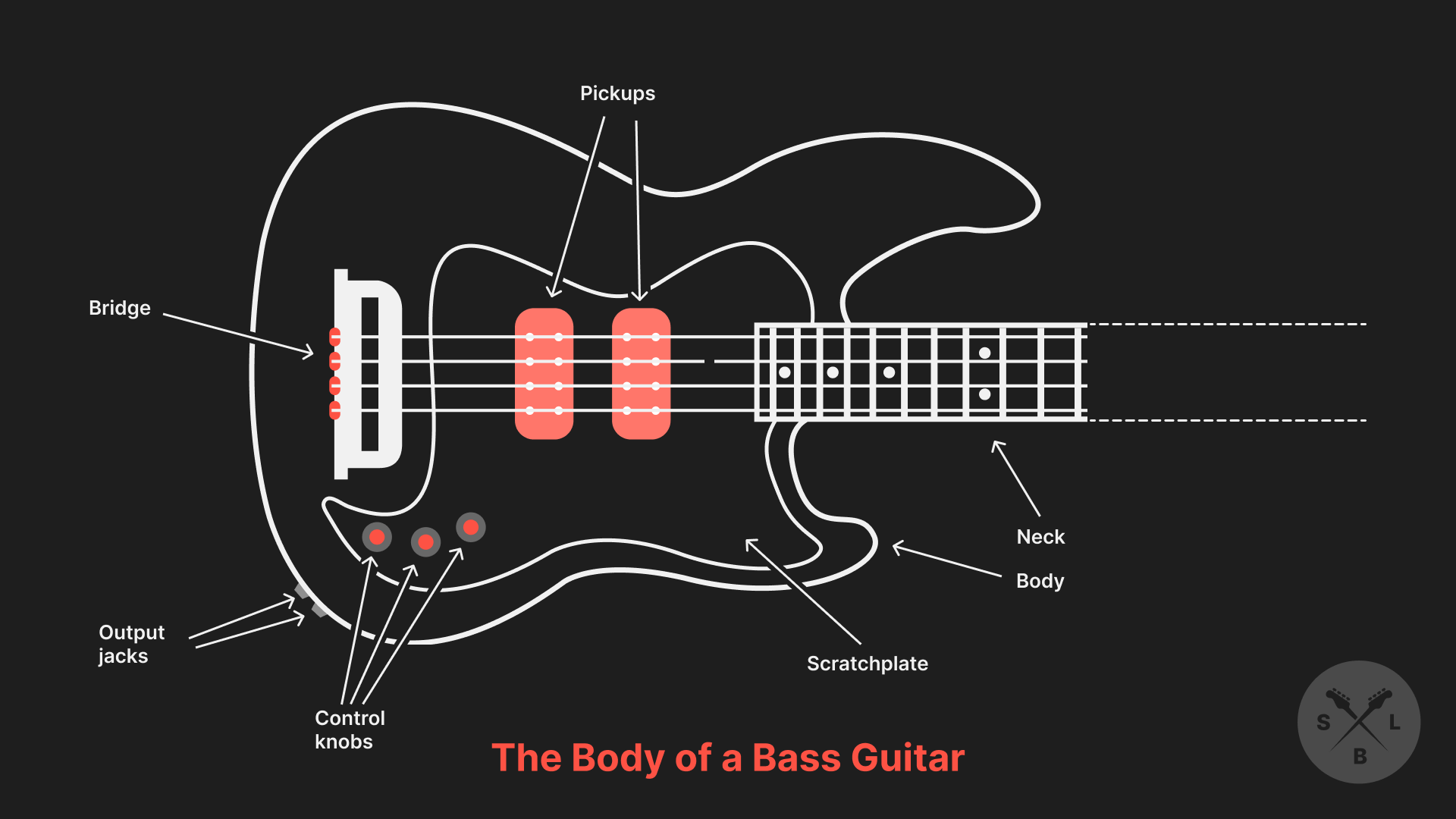
The body is the main section of the bass. It plays a vital role in the bass’s overall tone, sustain, and resonance.
The body is typically made from wood like alder, ash, or mahogany. The kind of wood used for the body changes the bass’s tone and weight, so it’s a really important factor.
Some basses even have semi-hollow bodies, which are lighter than solid bodies and produce unique tonal characteristics.
But the body isn’t simply just a piece of wood—it has a lot of different parts to it!
1. Pickups
Pickups are electromagnetic devices mounted onto the body of the bass that capture the strings' vibrations and turn them into electrical signals.
Pickups are essential for shaping the bass’s tone and pumping the sound through an amp or PA system.
The two most common types of bass pickups are single-coil and humbuckers. Single-coil pickups give a bright and punchy sound. Humbuckers, on the other hand, produce a warmer, more robust tone.
Many basses feature a combination of both pickup types, giving you a wide range of options.
2. Bridge
The bridge is a metal piece that anchors the strings to the body. It maintains correct string spacing, height, and intonation.
Bridges come in two different designs:
- Fixed bridges are permanently fixed to the body of the bass. This means that you can’t adjust the intonation of the strings.
- Adjustable bridges have individual saddles for each string. These types of bridges give you more control over the intonation of your bass.
3. Scratchplate
The scratchplate is a protective plate mounted on the body of the bass. It protects the body’s finish from regular wear and tear, like scratches, that can happen through regular playing.
Scratchplates are usually made from plastic or other durable materials. Typically, basses have a scratchplate under the strings, covering the area around the pickups and control knobs.
Scratchplates come in various shapes and sizes, depending on the bass model and the pickup configuration.
They also contribute to the bass’s overall look and can be decked out in unique colors or even artwork!
4. Control Knobs
Control knobs are little dials that let you adjust things like volume, tone, and pickup balance to achieve your desired sound.
The most common control knobs are volume knobs and tone knobs.
Volume knobs regulate the overall output level of the pickups (how loud it is), while tone knobs adjust the high-frequency response (how much bass or treble there is).
Some basses may have additional controls, like pickup blend knobs or EQ controls. All of these give you more control over how you shape your tone.
5. Output Jacks
The output jack connects your bass to your amp and is usually located on the side or edge of the body near the control knobs.
Output jacks come in different sizes with the most common size being ¼ inch (6.35mm).
The output jack should be one of the first places you check if your sound cuts out from the amp. There’s a risk of interference if it’s not securely mounted and properly connected to the bass’s electronics.
Additional Components
Alright, so we just looked at quite a few different bass components, but there are more!
1. Strap Buttons
Strap buttons are small, sturdy metal or plastic attachments mounted on the body that let you connect a strap to your bass.
These are essential for playing the bass comfortably while standing up.
Most basses have two strap buttons—one at the base of the body, near the output jack, and the other on the upper horn (the extension located on the upper side of the body near the neck joint).
Strap buttons securely hold the strap in place to prevent the bass from slipping or falling while you’re shredding.
2. Battery Compartment
Battery compartments aren’t a feature for every bass. That’s because bass guitars have two electronic types—active and passive.
A bass with active electronics has a battery-powered built-in preamp and equalizer. On the other hand, a bass with passive electronics relies solely on the natural resonance of the wood and the pickups to produce their sound.
Active basses require a power source—that’s where the battery compartment comes in. These typically take a 9-volt battery.
The battery compartment can be on the body's front, back, or side. It’s designed to keep the battery secure and protect it from damage.
To access the battery, you’ll need to unscrew a panel or remove a cover.
From Bass Parts to Bass Playing
Getting a handle on the parts of a bass guitar is important for a bassist at any level.
But what’s just as important is having a great teacher to guide you along the way.
And who are better teachers than some of the most talented bass players around?
The SBL Academy has a TON of video lessons from some of the world’s best bass players and teachers!
When you sign up, you get a personalized roadmap based on your skill level.
It’s pretty cool, right?
Start the next phase of your bass-playing journey. Try the SBL Academy free for 14 days!