
NEW Program Alert: The Groove Accelerator is OPEN for enrollment! Limited Time Only —Join Now
Reggae Bass Lines: The Ultimate Guide to Laid Back Grooves
There's something undeniably magnetic about reggae bass that just pulls you in—the way it transforms a simple bass line into a vibe that gets deep into your bones.
If you want to create your own reggae groove but find yourself doubting your abilities then keep reading.
By the end of today’s post, you'll not only understand the feel of reggae bass, but you’ll also be able to bring your own laid-back grooves to life.
Let’s get started.
What Reggae Bass Lines Sound Like
Reggae bass lines have a unique character that sets them apart from other musical genres. But what exactly makes them so instantly recognizable?
Rhythmic Patterns
Reggae bass is ALL about the rhythm.
Specifically, the "one drop rhythm"—a reggae staple where the bass drum hits on the third beat of every four-beat bar.
This leaves a space in the first beat and creates a sense of anticipation.
As a bassist, you'll find yourself weaving around this space, usually not playing on the first beat of the bar.
The emphasis in Reggae tends to be on beats two and four—which can feel counterintuitive if you’re used to playing pop or rock songs.
Swing Not Straight
The rhythm in reggae is usually played in swing style.
That means notes are typically played in a long-short pattern to create a distinctive groove.
You can also use a combination of swing AND straight. (Check out the first example bass line for an example.)
Melodic Structure
A reggae bass line melody is usually a simple, repeating pattern.
Think in terms of “call-and-response”.
The first phrase of the bass line “asks” a question. Then, after a short rhythmic space, the second phrase “answers” the question.
Bob Marley's Stir It Up is an excellent example of this.
You can also check out the tabs in the next section for another example.
What Notes Should I Use?
If you’re looking for an easy way to choose notes for your reggae bass line, using an arpeggio is a safe bet.
Using the root, fifth, and octave gives you a good framework to work with.
However, unlike pop music or other genres, reggae doesn’t have to start on a root note.
It’s common for a reggae bass line to start on the fifth.
Sound Quality
Reggae bass is deep, warm, and resonant.
It's not about slapping or aggressive playing. It's about letting each note ring out, filling the room with a kind of warmth that you can almost feel on your skin.
Reggae Bass Tabs
Understanding reggae bass requires more than just theory—it's about getting your hands on your bass and feeling the groove.
So let's look at two basic reggae bass lines as your first steps into the reggae world.
We’ll use the harmonic progression:
| G | Am | |
Here’s an Example Bass Line:
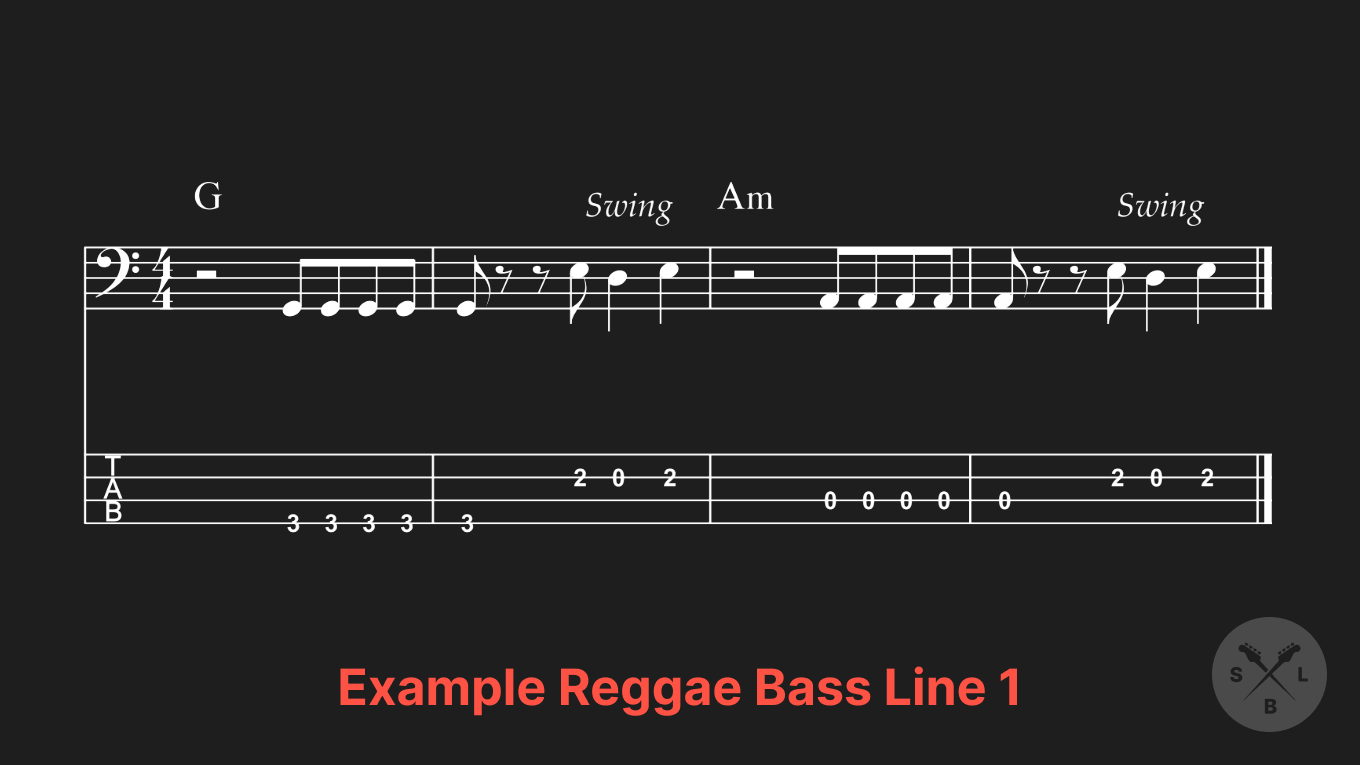
Notice how the groove doesn’t start on beat one of the bars to signal the chord change—the emphasis is on beat three.
The melody also has a “call-and-response” vibe.
There are two ways this is done:
- The space in between the parts
On bars one and two, and then again on bars three and four—the space separates the phrase into two.
- The different rhythms
The first half of the pattern is played with a straight rhythm, while the second half is played with a swing rhythm.
This creates an interesting rhythmical effect that’s common in Reggae.
Here’s Another Example Bass Line:
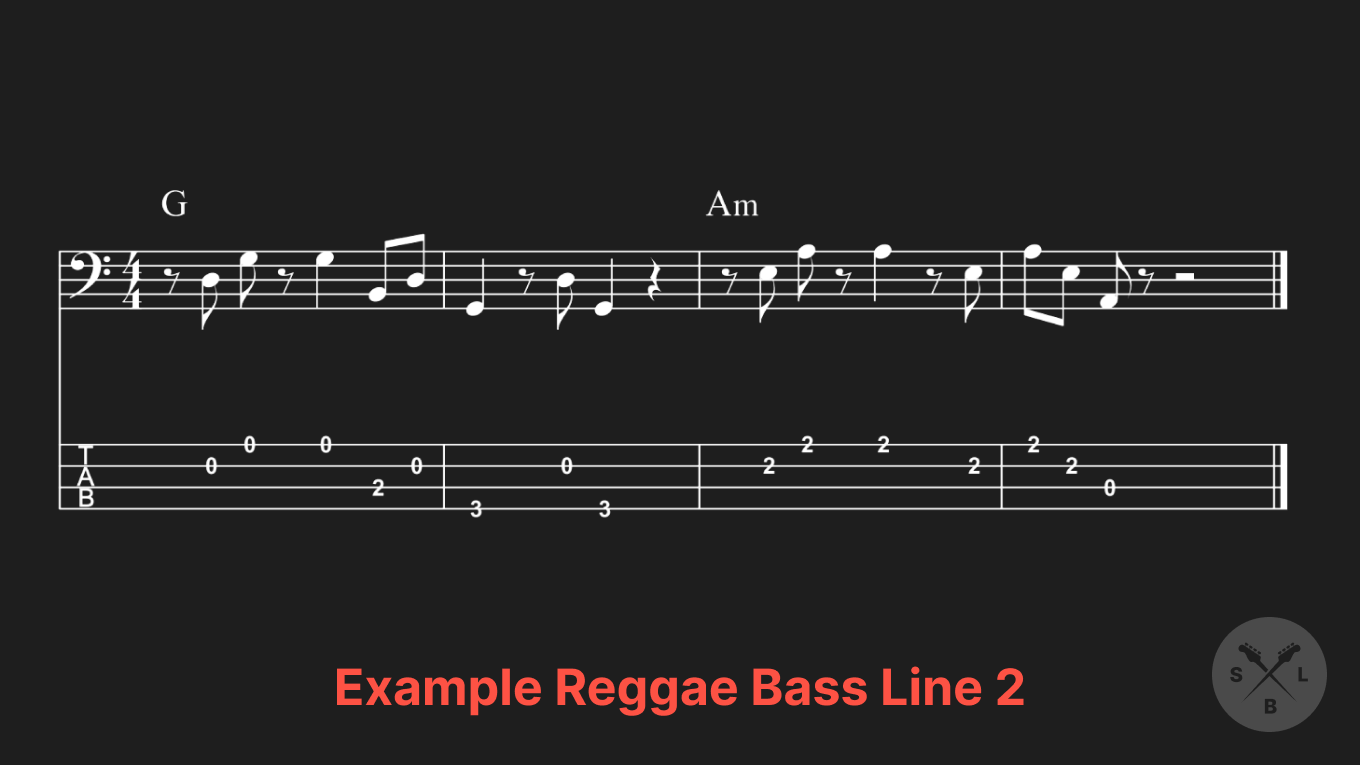
Notice how this bass line does NOT start on the root note.
This is very common. Reggae bass lines usually start on the 3rd or the 5th of the chord.
The notes in bars one and two make up a G major arpeggio (D, G, and B).
While the notes in bars three and four are just playing the Root, 5th, and Octave (A and E).
Tips When Playing Reggae Basslines
If you’re looking to level up your reggae grooves, here are a few tips you can use to improve:
1. Leave (a Lot) of Space in Your Bass Line
That “call-and-response” only happens when there’s a space in between the melodic parts. The gap is what makes a reggae bassline so groovy.
So make sure you let the bassline breathe and give it space.
2. Focus On the Off-Beat
Normally, the bass and the drums are “in sync”.
In pop and rock, for example, both the bass and drums emphasize the beats one and three.
But reggae is syncopated.
The bass and the drums each do their own thing. They intersect at specific moments and emphasize different beats within the bar.
So focus on the off-beat, on what your bassline is doing, and trust that it’s still adding to the groove.
3. Experiment With Tone
Like any genre, your tone can change the entire feel of a bass line.
With reggae, you want to aim for a warm, rounded tone.
Keep in mind that there’s no single set of parameters.
Experiment with different tone settings on your amp and guitar, using flat-wound strings, and plucking near the neck.
Practice playing with your thumb if you want to expand your sound and plucking technique.
Find that authentic reggae sound that YOU like.
4. Practice With Drums
Reggae is deeply intertwined with the drums, especially that one-drop beat. So practicing with a drummer or even a drum machine can help you lock in that reggae rhythm.
The better you understand the groove, the more fluid your playing becomes.
5. Keep It Simple
Simplicity is the key to reggae.
You want a melodic line that sticks in the listener's mind. When in doubt, remember that less is more.
Songs With the Best Reggae Bass Lines
Each of the following songs offers a unique insight into reggae bass. By listening to them, you can absorb the essence of what makes them great. So consider listening to the following songs as your “homework”.
1. Heroes Dead And Gone: Eek A Mouse
This track is a masterclass in using space. The bass line is minimal, and leaves room for the vocals to breathe, yet every note hits with impact.
2. Headache: The Revolutionaries
"Headache" features a bassline that's both rhythmic and melodic. It drives the song forward while weaving its own narrative.
3. Music Is My Desire: Pablo Moses
Here, the bass takes a more melodic approach, almost singing along with the vocals. It’s a perfect example of how the bass can lead in reggae.
4. Yellowman: Sensemilla
In "Sensemilla," the bass line is a groove powerhouse. It’s a study of how to create a compelling rhythm that’s impossible not to nod your head to.
5. Reggae in the Grass: Sound Dimension
This track showcases a classic reggae bass sound—deep, warm, and vibrant. It’s a lesson in tone and feel.
Trying to Master Reggae? Avoid This Common Mistake.
Imagine yourself a few months from now, bass in hand, effortlessly jamming through reggae grooves that once seemed intimidating.
The only thing stopping you (and so many aspiring bassists) from getting to that point, is giving up.
There are a lot of nuances to reggae.
Because of this, what tends to happen is that you’ll get stuck on a technique, look for help online, and learn a bunch of confusing techniques that leave you with more questions than answers.
The solution is simple.
You need an instructional path based on your specific skill level.
So that you know, without a shadow of a doubt, that what you’re working on right now, is exactly what you need to get your bass playing to the next level.
And that’s exactly what you get when you join the SBL Academy.
Right now, you can try it FREE for 14 days!